

TL;DR:
- An OUI arrest in Massachusetts triggers both an immediate RMV administrative suspension and a separate criminal court process. Each system imposes its own penalties, which can stack or overlap, affecting license status and legal consequences. Managing both processes simultaneously requires prompt legal action and careful coordination to minimize long-term impacts.
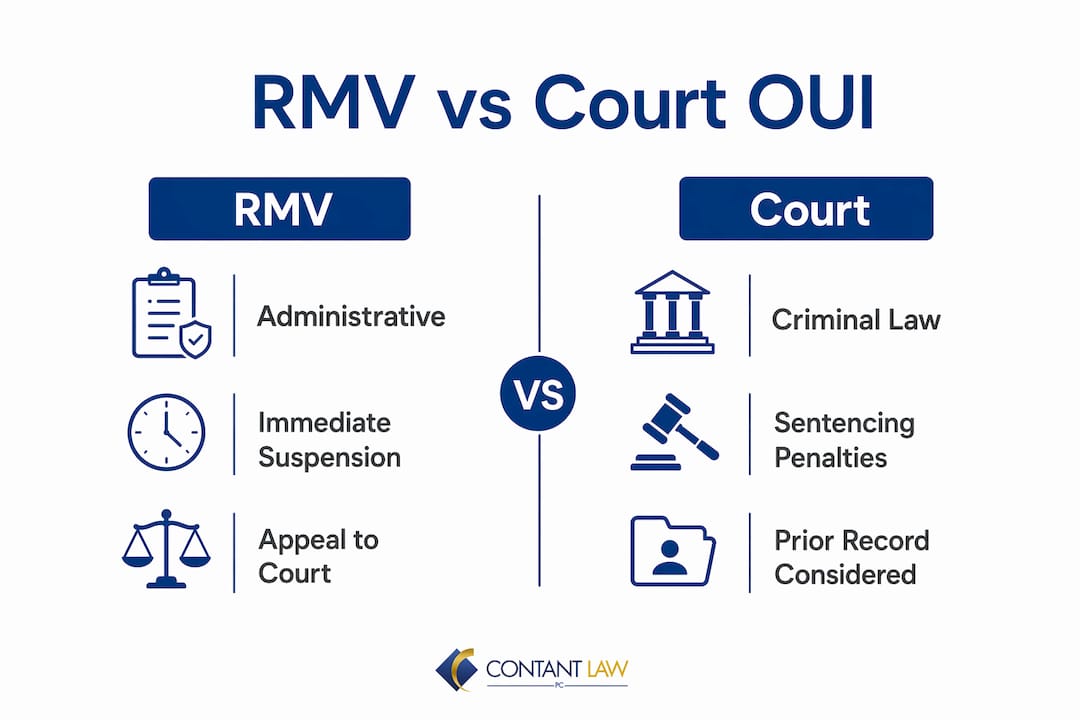
An OUI arrest in Massachusetts triggers two separate legal processes at the same time. The Registry of Motor Vehicles (RMV) handles your license through administrative suspension under Massachusetts General Laws Chapter 90 Section 24, while the criminal court handles your charges, trial, and sentencing. Understanding the difference between RMV vs court OUI proceedings in Massachusetts is not optional. Each system operates on its own timeline, imposes its own penalties, and requires its own response from you.
What is the RMV hearing process in Massachusetts?
The RMV acts immediately after an OUI arrest. Under Massachusetts implied consent law, the RMV imposes a 30-day administrative suspension if your Blood Alcohol Concentration (BAC) tests at 0.08 or higher. That suspension begins without any notification period. You do not get a warning or a grace period.
The RMV handles several types of suspension hearings:
- Chemical test refusal suspensions. Refusing a breathalyzer triggers a separate administrative suspension that stacks with court penalties. The refusal itself is not a criminal offense, but the RMV treats it as an independent violation.
- Youth suspensions. Drivers under 21 face stricter BAC thresholds and longer suspension periods under Massachusetts law.
- Court-ordered suspensions. After a conviction, the court can direct the RMV to impose additional suspension time on top of what the RMV already imposed.
You can appeal an RMV suspension to the district court, but the process is narrow. The RMV requires a hearings officer meeting before reinstating any license. At that meeting, you may need to show hardship, prove compliance with any required programs, and in some cases demonstrate that an Ignition Interlock Device (IID) has been installed.
A 24D disposition from the court can reduce your RMV suspension significantly. First-time offenders who qualify can cut their suspension from one year down to 45 days by completing a Driver Alcohol Education Program. That outcome comes from the court, but it directly changes what the RMV does with your license.
Pro Tip: Request your RMV hearing as quickly as possible after your arrest. Delays can cost you the chance to argue for a hardship license while your case is still pending in court.
How does the Massachusetts court OUI process work?
The criminal court process runs on a different track from the RMV. After your arrest, the court process moves through these stages:
- Arraignment. You appear before a judge, hear the charges, and enter a plea. Most defendants plead not guilty at this stage to preserve their options.
- Pre-trial hearings. Your attorney can file motions to suppress evidence, challenge the arrest, or negotiate with the prosecutor.
- Trial or plea. You either go to trial or accept a plea agreement. For first-time offenders, a 24D disposition is often the most favorable outcome available.
- Sentencing. A conviction brings criminal penalties including jail time, fines, probation, and mandatory education programs.
Court-imposed penalties are distinct from RMV administrative actions. Criminal sentencing can include additional license suspension on top of what the RMV already imposed. A first-offense conviction carries a standard one-year license suspension from the court, separate from the RMV’s immediate 30-day suspension. That means both systems can suspend your license, and those suspensions can overlap or stack depending on timing.
The court also considers your prior record. Massachusetts enforces a lifetime lookback period for OUI offenses. A conviction from 20 years ago still counts as a prior offense today. That prior conviction affects both the court’s sentencing and the RMV’s suspension calculation.

Key differences between RMV and court OUI penalties
The RMV operates under administrative law. The court operates under criminal law. Those are fundamentally different systems with different standards of proof and different consequences.
| Offense level | RMV suspension | Court suspension | Additional court penalties |
|---|---|---|---|
| First offense | 30 days (arrest) + 1 year (conviction) | 1 year (45 days with 24D) | Fines, probation, education program |
| Second offense | 2 years | 2 years | Jail time, IID requirement |
| Third offense | 8 years | 8 years | Mandatory jail, IID |
| Fourth offense | 10 years | 10 years | Mandatory jail, IID |
| Fifth offense | Lifetime revocation | Lifetime revocation | Mandatory jail |
Suspension durations escalate steeply with each offense. That escalation reflects Massachusetts’s intent to treat repeat OUI offenders with increasing severity. Massachusetts also requires IID installation for drivers with two or more OUI convictions, and that requirement extends through the suspension period and beyond full reinstatement.
Chemical test refusal adds another layer. The RMV imposes a refusal suspension that runs separately from any court-ordered suspension. If you refuse the breathalyzer and are later convicted, you serve both suspensions. That can add years to your total time without a license.
Pro Tip: Never assume that winning your court case clears your RMV record. A not-guilty verdict in court does not automatically lift an RMV suspension for test refusal. You must address each process separately.
How to handle both RMV and court proceedings after an OUI arrest
Managing both processes at once is the central challenge of an OUI arrest in Massachusetts. The steps below reflect what actually matters in the days and weeks after your arrest.
- Act on the RMV immediately. The 24-hour window after arrest sets the tone for everything that follows. Contact an attorney before that window closes.
- Gather documentation for a hardship license. The RMV requires evidence that losing your license creates genuine hardship. Employment records, medical appointments, and childcare obligations all support that argument.
- Understand your 24D eligibility. Not every first-time offender qualifies. Your attorney needs to assess your record, the circumstances of the arrest, and the strength of the prosecution’s evidence before recommending a 24D plea.
- Track both timelines. Your RMV suspension and your court case move on different schedules. A court continuance does not pause your RMV suspension.
- Plan for reinstatement. The license reinstatement process requires meeting RMV conditions, paying fees, and in some cases completing an IID period. Start planning before your suspension ends, not after.
Outcomes in one system affect the other. A 24D disposition in court reduces your RMV suspension. A court conviction triggers additional RMV action. Understanding how those connections work is where legal representation pays off most clearly. Readers who want to understand their options for a first-time charge will find that the court and RMV processes are deeply linked.
If you are dealing with an underlying alcohol issue, alcohol abuse treatment can also factor into sentencing discussions and demonstrate good faith to the court.
Key Takeaways
In Massachusetts, an OUI arrest activates both an immediate RMV administrative suspension and a separate criminal court process, and each system imposes its own penalties that can stack against you.
| Point | Details |
|---|---|
| RMV acts immediately | A 30-day administrative suspension begins at arrest with no notification period. |
| Court and RMV penalties stack | Court-ordered suspensions add to RMV suspensions; they do not replace them. |
| 24D disposition reduces suspension | First-time offenders can cut their suspension from one year to 45 days through the court. |
| Lifetime lookback applies | Prior OUI convictions from any point in your past increase both RMV and court penalties. |
| Test refusal runs separately | Refusing a breathalyzer triggers an independent RMV suspension regardless of court outcome. |
What I’ve learned from handling both sides of an OUI case
Most people who come to Contant-law after an OUI arrest are focused entirely on the court case. That instinct is understandable. Criminal charges feel urgent. But the RMV process is where people lose the most ground early on, and it happens quietly while they are waiting for their court date.
The most common mistake I see is treating the RMV hearing as a formality. It is not. A hardship license hearing requires real preparation and real documentation. Showing up without evidence of hardship almost always results in a denial. That denial can cost someone their job before the court case even begins.
The 24D disposition is genuinely valuable for eligible first-time offenders, but it is not automatic. The prosecution has to agree, and the judge has to accept it. I have seen clients assume they qualify and then discover a prior record they had forgotten about. Massachusetts’s lifetime lookback rule has no exceptions. A conviction from 30 years ago still counts.
The practical advice I give every client is this: treat the RMV and the court as two separate cases that happen to share the same arrest. Each one needs its own strategy, its own documentation, and its own timeline. Getting that right from the start is what separates a manageable outcome from a preventable disaster.
— Contant Law
Contant-law’s OUI defense services in Massachusetts
Facing both an RMV suspension and criminal OUI charges at the same time is genuinely complex. Contant-law represents clients across Massachusetts in both RMV hearings and criminal court, with offices in Woburn and Newburyport. The firm’s attorneys understand how outcomes in each process affect the other, and they work to protect your license and your record from the moment of arrest. Whether you need help pursuing a hardship license, evaluating 24D eligibility, or building a defense for trial, Contant-law provides clear guidance at every stage. Review the full range of OUI fines and penalties or visit Contant-law’s main services page to connect with an attorney today.
FAQ
What is the difference between an RMV and court OUI suspension?
The RMV imposes an administrative suspension immediately after arrest, while the court imposes a criminal suspension only after a conviction. Both can apply at the same time, and they do not cancel each other out.
What happens at an RMV OUI hearing in Massachusetts?
A hearings officer reviews your case and determines whether you qualify for license reinstatement or a hardship license. You may need to provide documentation of hardship and proof of compliance with any required programs or IID installation.
Can I get my license back faster with a 24D disposition?
Yes. A 24D disposition reduces a first-offense suspension from one year to 45 days, provided you complete the Driver Alcohol Education Program and meet all RMV requirements.
Does refusing a breathalyzer help my court case in Massachusetts?
Refusing a breathalyzer prevents BAC evidence from being used in court, but it triggers a separate RMV administrative suspension that stacks with any court-ordered suspension. The trade-off requires careful legal analysis.
How does Massachusetts’s lifetime lookback rule affect my OUI case?
Massachusetts counts every prior OUI conviction regardless of when it occurred. A second offense from decades ago still elevates your current charge to a higher offense level, increasing both RMV suspension length and criminal penalties.
Recommended
- OUI Defense Process in Malden, Massachusetts: 2026 Guide
- What Happens in the 24 Hours Following an OUI Arrest? | Massachusetts | Contant Law, P.C.
- The Difference Between DUI and OUI in Massachusetts | Woburn Defense Lawyers
- New Case Alert: MA Supreme Judicial Court Case Makes It Easier To Overturn Old DUI / OUI Conviction | Contant Law, P.C.


