

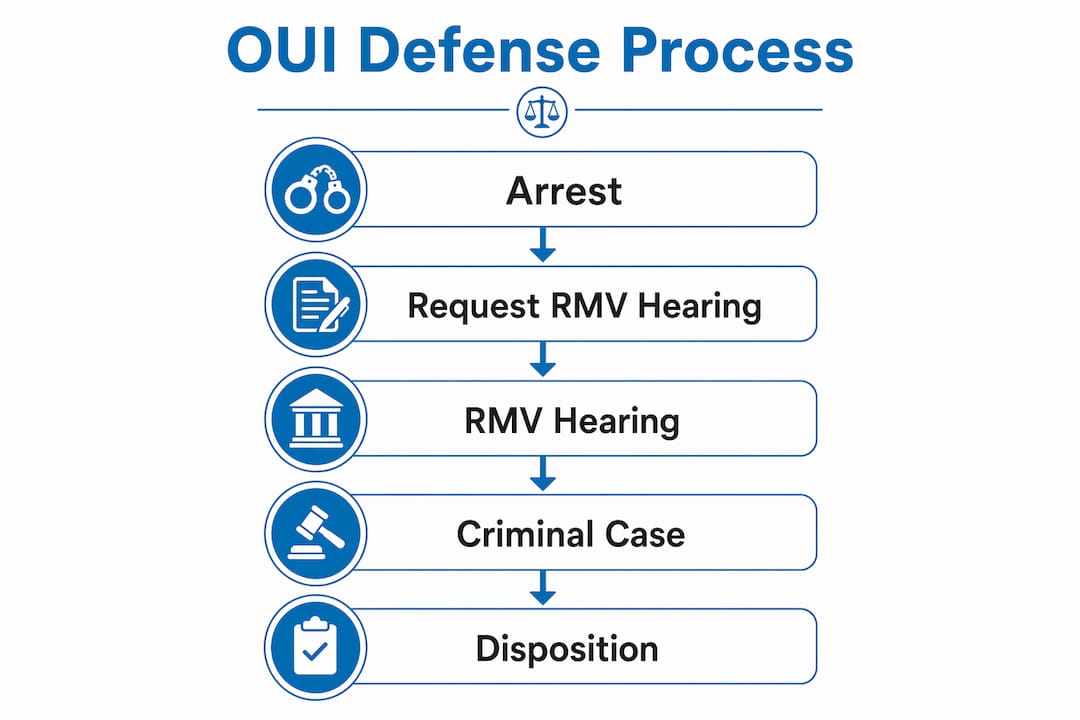
An OUI arrest in Malden, Massachusetts triggers two simultaneous legal proceedings: a criminal case in Malden District Court and an administrative license suspension hearing at the Registry of Motor Vehicles. Most people focus only on the criminal case and miss the RMV deadline entirely. That mistake can cost you months of driving privileges before your court date even arrives. Understanding the full OUI defense process in Malden, Massachusetts, including both tracks, gives you the best chance of protecting your rights, your license, and your record under M.G.L. c. 90.
What happens immediately after an OUI arrest in Malden?
The moment police place you under arrest for OUI in Malden, two clocks start running at the same time. The criminal case begins at Malden District Court. The administrative license suspension process begins at the Massachusetts Registry of Motor Vehicles. Both require your attention within days, not weeks.
Here is the sequence of events you should expect:
- Booking and charges. Police bring you to the station for booking. You are formally charged under M.G.L. c. 90, Section 24, which governs OUI offenses in Massachusetts.
- Breathalyzer decision. Officers will ask you to submit to a breathalyzer test. Massachusetts operates under an implied consent law, meaning your license is automatically subject to suspension if you refuse or fail.
- License suspension notice. If you fail the breathalyzer with a Blood Alcohol Concentration of 0.08% or higher, or if you refuse the test, your license is suspended on the spot. You receive a temporary paper license.
- Arraignment. Your first court appearance at Malden District Court typically occurs within one to two business days. You enter a plea, and bail conditions may be set.
- RMV hearing request window. You have 15 days to request an RMV administrative hearing to contest the license suspension. Miss that window and the suspension stands automatically.
The 15-day deadline is the most overlooked step in the entire process. An OUI arrest triggers both criminal and administrative proceedings simultaneously, and most people lose their driving privileges simply because they did not know to request the hearing in time.
Pro Tip: Request your RMV administrative hearing the same day you hire an attorney. Do not wait until after your arraignment. The 15-day window runs from the date of arrest, not from your first court date.
Evidence collected at the scene, including the officer’s field sobriety test observations, dashcam footage, and any breathalyzer readings, forms the foundation of the criminal case. Your attorney can begin challenging that evidence immediately.
How does the RMV administrative hearing work?
The RMV administrative hearing is a separate process from your criminal case. It does not determine guilt or innocence. It determines only whether your license suspension was lawfully imposed.
Key facts about the RMV hearing process:
- Breathalyzer failure suspension. If you failed the breathalyzer, your license is suspended for 30 days on a first offense pending the hearing outcome.
- Breathalyzer refusal suspension. Refusing the breathalyzer triggers a 180-day suspension for a first offense. Refusal removes breath test results as evidence in criminal court, but the administrative penalty is significantly longer.
- Hearing procedure. An RMV hearing officer reviews whether the stop was lawful, whether the officer had probable cause, and whether proper procedures were followed.
- Outcome independence. License suspensions arise separately from the RMV administrative hearing and the criminal court conviction. Winning one does not automatically resolve the other.
| Scenario | Administrative suspension (first offense) | Breath test evidence in court |
|---|---|---|
| Breathalyzer failure (BAC 0.08%+) | 30 days | Admissible |
| Breathalyzer refusal | 180 days | Not admissible |
A timely RMV hearing request and strong evidence presentation can preserve your driving privileges while the criminal case proceeds. That is a meaningful advantage when a criminal case can take six months or longer to resolve.
If you lose the RMV hearing or choose not to request one, hardship licenses may be available to maintain limited driving access during the suspension period. Hardship licenses typically allow driving to work, school, or medical appointments under restricted hours.
Pro Tip: Bring documentation of your employment, medical needs, or school schedule to your hardship license application. The RMV requires proof that the suspension creates a genuine hardship.
What is the criminal court process for OUI charges in Malden?
The criminal case for an OUI charge in Malden proceeds through Malden District Court. The process moves from arraignment through pretrial hearings, potential motions to suppress evidence, and ultimately a trial or negotiated resolution.

Massachusetts OUI law classifies offenses into five tiers with escalating penalties. A first offense is a misdemeanor. A fourth or fifth offense reaches felony level with possible state prison time. The tier that applies to your case shapes every aspect of the defense strategy.
Common defense approaches include:
- Challenging breathalyzer accuracy. Breathalyzer machines require regular calibration and proper administration. Errors in either area can make the results inadmissible.
- Questioning field sobriety tests. Standardized field sobriety tests, including the Walk-and-Turn and One-Leg-Stand, have known limitations. Medical conditions, uneven road surfaces, and poor lighting all affect performance.
- Suppressing unlawful stops. If the officer lacked reasonable suspicion to pull you over, a motion to suppress can exclude all evidence gathered after the stop.
- Distinguishing alcohol from drug OUI. Defense strategies must adapt depending on whether the OUI involves alcohol, marijuana, or prescription medications. Drug-related OUI cases rely on different evidence standards and expert testimony.
“Qualified first-time offenders in Massachusetts may be eligible for a 24D disposition, which offers a reduced license suspension of typically 45–90 days, mandatory alcohol education, and no permanent criminal conviction. This outcome is not automatic. It requires a skilled OUI defense attorney to negotiate and present the case effectively.”
The 24D disposition is one of the most significant tools available in a first-offense case. It keeps a conviction off your permanent record, which matters for employment, professional licenses, and future legal proceedings. You can challenge a DUI/OUI arrest on multiple grounds, and an experienced attorney will evaluate every angle before recommending a path forward.
What are the penalties for OUI convictions in Massachusetts?
OUI penalties in Massachusetts escalate sharply with each offense tier. The consequences extend well beyond fines and jail time. License suspensions, mandatory programs, and long-term record implications all compound the impact of a conviction.
| Offense tier | Possible jail time | License suspension | Fine range |
|---|---|---|---|
| First offense | Up to 2.5 years | 1 year | $500–$5,000 |
| Second offense | 30 days–2.5 years | 2 years | $600–$10,000 |
| Third offense | 150 days–5 years | 8 years | $1,000–$15,000 |
| Fourth offense (felony) | 1–5 years state prison | 10 years | $1,500–$25,000 |
| Fifth offense (felony) | 2–5 years state prison | Lifetime | $2,000–$50,000 |
An OUI conviction in Massachusetts stays on your record for a long time. Understanding how long an OUI stays on your record is critical for planning your defense strategy and evaluating whether a 24D disposition or other alternative makes sense for your situation.
The distinction between administrative and criminal penalties matters here. You can face both a criminal conviction and a separate RMV suspension for the same arrest. Resolving the criminal case does not automatically restore your license. Each process requires separate action, and getting your license back after an OUI arrest involves specific steps with the RMV that must be completed independently of the court outcome.
Key Takeaways
An OUI arrest in Malden, Massachusetts requires immediate action on two fronts: the criminal case at Malden District Court and the administrative license suspension hearing at the RMV.
| Point | Details |
|---|---|
| Two simultaneous proceedings | An OUI arrest triggers both a criminal case and an RMV administrative hearing at the same time. |
| 15-day RMV deadline | You must request an RMV hearing within 15 days of arrest to contest your license suspension. |
| Breathalyzer refusal consequences | Refusing the breathalyzer suspends your license for 180 days but removes breath test evidence from court. |
| Five offense tiers | Massachusetts law escalates OUI penalties from misdemeanor to felony based on prior offenses. |
| 24D disposition option | First-time offenders may qualify for a 24D disposition, avoiding a permanent criminal conviction. |
What I have learned about OUI defense timelines
The single biggest mistake I see people make after an OUI arrest is treating it as one problem instead of two. They hire an attorney, show up for arraignment, and assume the license issue will sort itself out. It does not. The RMV process runs on its own clock, and that clock does not wait for the court case.
The 15-day window to request an RMV hearing is not a suggestion. Miss it, and you lose the ability to contest the suspension entirely. For someone who drives to work, drives their kids to school, or lives in a part of Massachusetts without reliable public transit, that suspension is not a minor inconvenience. It is a serious disruption to daily life that can last months.
The other thing I want to be direct about: the criminal case outcome and the RMV outcome are genuinely separate. I have seen people win their criminal case and still lose their license because they did not address the administrative side. I have also seen people lose at the RMV hearing but successfully negotiate a 24D disposition in court that kept a conviction off their record. You need a defense approach that covers both tracks from day one.
Selecting an OUI defense attorney in Malden means finding someone who understands both Massachusetts criminal procedure and RMV administrative practice. Those are different skill sets. Ask any attorney you consult whether they handle both the criminal case and the RMV hearing, and how they coordinate the two. The answer tells you a great deal about their experience.
— Rich
How Contant-law supports OUI defense in Massachusetts
Contant-law handles OUI defense across Massachusetts, including cases originating in Malden District Court. The firm manages both the criminal case and the RMV administrative hearing, so nothing falls through the cracks on either track. Whether you are facing a first offense and exploring a 24D disposition or dealing with a more serious repeat charge, Contant-law builds a defense strategy matched to your specific facts and offense tier. The firm also assists with hardship license applications and license reinstatement steps. If you are facing OUI charges and need clear guidance on your options, contact Contant-law to discuss your case directly with an experienced Massachusetts OUI defense attorney.
FAQ
What is the OUI defense process in Malden, Massachusetts?
The OUI defense process in Malden involves two parallel tracks: a criminal case at Malden District Court and an administrative license suspension hearing at the Massachusetts RMV. Both must be addressed simultaneously for the best outcome.
How long do I have to request an RMV hearing after an OUI arrest?
You have 15 days from the date of arrest to request an RMV administrative hearing. Missing this deadline means the license suspension takes effect automatically without any opportunity to contest it.
What is a 24D disposition in a Massachusetts OUI case?
A 24D disposition is available to qualified first-time OUI offenders and results in a reduced license suspension of typically 45–90 days, mandatory alcohol education, and no permanent criminal conviction on your record.
Does refusing a breathalyzer help my case in Massachusetts?
Refusing the breathalyzer removes breath test results as evidence in criminal court, but it triggers a 180-day administrative license suspension for a first offense. The trade-off requires careful evaluation with an OUI defense attorney.
Can an OUI conviction be removed from my record in Massachusetts?
An OUI conviction stays on your Massachusetts driving record for a significant period, and options for sealing depend on the disposition type. A 24D disposition offers a path that avoids a permanent conviction, making it one of the most important outcomes to pursue in a first-offense case.


