

Negligent operation under Massachusetts law is defined as operating a motor vehicle in a way that endangers the public, as codified in M.G.L. c. 90, § 24(2)(a). This charge is a criminal misdemeanor, not a civil traffic ticket, which means a conviction creates a permanent criminal record. The stakes are serious: you face potential imprisonment, fines, mandatory assessments, and an automatic license suspension handled separately by the Massachusetts Registry of Motor Vehicles (RMV). Understanding negligent operation defense strategies in Massachusetts is the first step toward protecting your license, your record, and your future. The charge differs from reckless operation, which requires conscious disregard of risk. Negligent operation requires only that your driving fell below the reasonable care standard, making it easier for prosecutors to pursue but also easier to challenge with the right defense.
What are the legal elements the prosecution must prove for negligent operation in Massachusetts?
The prosecution carries the full burden of proof on every element of a negligent operation charge. If your defense creates reasonable doubt on even one element, the charge cannot stand.
The three core elements prosecutors must establish are:
- Operation of a motor vehicle. The defendant must have been driving or in control of the vehicle. This element is rarely contested but can matter in cases involving parked vehicles or disputes about who was driving.
- Negligent conduct. The prosecution must show your driving fell below the standard of a reasonably careful driver. Negligent operation charges can be based on behaviors like speeding, lane weaving, or aggressive tailgating, and no accident is required. That last point surprises many people: you can be charged even if no collision occurred.
- Endangerment of public safety. The driving must have put at least one other person at risk. This can include other drivers, pedestrians, or passengers in your own vehicle.
Understanding these elements matters because each one is a potential target for your defense. A skilled attorney examines whether the evidence actually supports each element or whether the prosecution is relying on incomplete or inconsistent proof. The reasonable care standard is also distinct from recklessness, which requires conscious disregard of risk. Prosecutors sometimes negotiate charges downward from reckless to negligent operation, which is itself a meaningful outcome worth pursuing.
Which defense strategies effectively counter negligent operation charges in Massachusetts?
Effective defense tactics for negligence charges in Massachusetts fall into several well-established categories. The strongest approach depends on the specific facts of your case, but these strategies form the foundation of most successful defenses.
Argue the driving was not negligent. The prosecution must prove your conduct fell below the reasonable care standard. If road conditions, traffic patterns, or an emergency situation explain your driving, that context can defeat the negligence element entirely. A sudden tire blowout or evasive action to avoid another driver’s error are examples where your response may have been reasonable under the circumstances.
Challenge the reliability of evidence. Inconsistencies in police reports, witness statements, and dashcam footage can create reasonable doubt. Officers sometimes write reports hours after an incident, and memory errors or incomplete observations are common. Dashcam footage that cuts off before the key moment, or witness accounts that contradict each other, can significantly weaken the prosecution’s case.
Raise comparative negligence or contributory fault. If another driver’s actions contributed to the incident, that fact is relevant to your defense. Massachusetts courts recognize that fault can be shared, and placing partial responsibility on another party can undermine the prosecution’s narrative.
Challenge procedural errors. Improper stops, arrests without probable cause, or RMV administrative errors can provide grounds to suppress evidence or dismiss the charge entirely. If the officer lacked a lawful basis to pull you over, everything gathered after that stop may be inadmissible.
Pursue a Continuance Without a Finding (CWOF). A CWOF allows you to avoid a formal conviction by completing a probationary period. After probation, the case is dismissed. You still face the $250 mandatory assessment, possible insurance surcharges, and RMV administrative penalties, but your criminal record does not carry a conviction. For many first-time defendants, a CWOF is the most practical outcome available.
Pro Tip: Request all police reports, dispatch logs, and any available video footage as early as possible. Evidence can be lost or overwritten quickly, and having it in hand gives your attorney the best chance to find inconsistencies before trial.
How do penalties vary for different offenders in Massachusetts?

Penalties for negligent operation in Massachusetts scale significantly based on your age, your driving history, and whether you hold a commercial license. The table below summarizes the key consequences.
| Offender category | License suspension | Fines and assessments | Additional consequences |
|---|---|---|---|
| Standard first offense | 60 days (RMV mandatory) | $20–$200 fine plus $250 mandatory assessment | Up to 2 years imprisonment possible |
| Standard second offense (within 3 years) | 1 year | Additional reinstatement fees | Increased court scrutiny |
| Junior operator (16½ to 18 years), first offense | 180 days | Same fines and assessment apply | No hardship license eligibility |
| Junior operator, second offense | 1 year under M.G.L. c. 90, § 24P(b) | Same fines and assessment apply | Stricter reinstatement requirements |
| Commercial driver (CDL holder) | Standard suspension plus federal CDL consequences | Same fines apply | Potential disqualification from commercial driving |
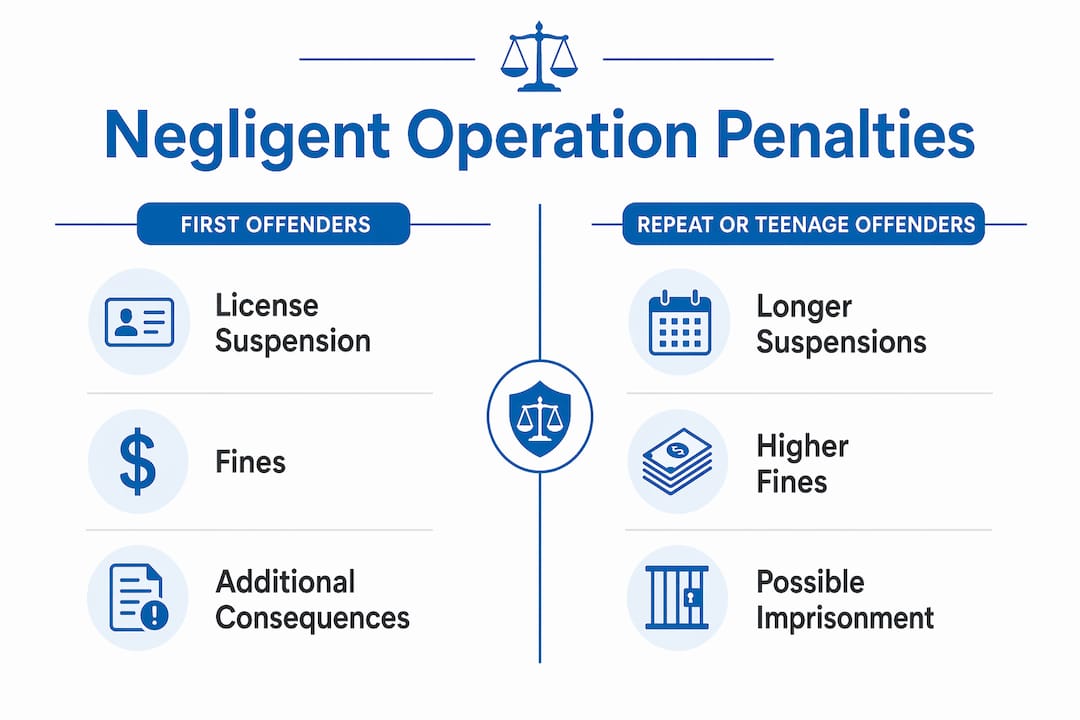
A first offense conviction carries 2 weeks to 2 years of possible imprisonment, a fine of $20–$200, and the $250 mandatory assessment. That assessment is non-negotiable regardless of the outcome in court. Junior operators face a 180-day suspension for a first offense, three times longer than the standard 60-day suspension, and they cannot apply for a hardship license during that period. The RMV imposes these suspensions automatically. A judge cannot waive them, which is why the administrative process demands as much attention as the courtroom.
What practical steps should you take after a negligent operation charge?
Acting quickly and deliberately after a negligent operation charge gives you the best chance at a favorable outcome. The following steps reflect what experienced Massachusetts defense attorneys consistently recommend.
- Retain legal counsel immediately. The court process and the RMV administrative process are separate, and both require attention. A not-guilty verdict in court does not automatically restore a license suspended by the RMV. You need an attorney who understands both tracks.
- Gather all available evidence. Collect photos of the scene, dashcam footage, witness contact information, and any documentation of road or weather conditions. Do this before memories fade and before any video footage is overwritten.
- Understand the RMV process. The RMV holds its own hearings and applies its own standards. Even if your criminal case resolves favorably, you may still need to request a separate RMV hearing to address your license suspension.
- Prepare for a hardship license hearing if eligible. Standard adult offenders may apply for a hardship license during the suspension period. Junior operators cannot. If you qualify, your attorney can help you present a strong case for limited driving privileges.
- Consider the long-term record impact. A conviction or even a CWOF can affect insurance rates and, in some cases, future employment. Understanding how convictions affect your record helps you weigh your options clearly before accepting any plea.
Pro Tip: Never assume that winning in court means your license is automatically restored. File a separate request with the RMV as soon as your court case concludes, and bring documentation of the outcome with you.
Key Takeaways
Defending a negligent operation charge in Massachusetts requires challenging the prosecution’s evidence on every element while simultaneously managing the separate RMV administrative process.
| Point | Details |
|---|---|
| Criminal charge, not a traffic ticket | Negligent operation is a misdemeanor that creates a permanent criminal record if convicted. |
| Three elements to challenge | Prosecution must prove operation, negligent conduct, and endangerment of public safety. |
| CWOF avoids a conviction | Completing probation under a CWOF results in dismissal, though fees and RMV penalties still apply. |
| RMV acts independently | A not-guilty verdict does not restore your license; a separate RMV hearing is required. |
| Junior operators face harsher terms | Drivers aged 16½ to 18 face a 180-day suspension for a first offense with no hardship license option. |
What I’ve learned defending these cases in Massachusetts
Negligent operation cases look straightforward on paper. In practice, they are rarely simple. The charge covers a wide range of driving behaviors, and the evidence is often thinner than the police report suggests. Officers write reports after the fact, witnesses misremember details, and dashcam footage frequently fails to capture the full picture. That gap between what the report says and what actually happened is where most defenses are built.
The piece that defendants most often underestimate is the RMV process. People focus entirely on the criminal case, win or reach a favorable resolution, and then discover their license is still suspended because they never addressed the administrative side. The court and RMV operate independently, and that separation catches people off guard. Losing your license for 60 days or 180 days is not a minor inconvenience. For most people, it means losing the ability to get to work, care for family members, or meet basic obligations.
My consistent advice is to treat the RMV hearing with the same seriousness as the criminal case. Prepare documentation, understand the reinstatement requirements, and do not wait until after the court case to start thinking about your license. The defendants who fare best are the ones who address both tracks from the beginning, not the ones who circle back to the RMV after the fact.
— Rich
Facing a negligent operation charge in Massachusetts
Negligent operation charges carry real criminal consequences, and the path through both the court system and the RMV requires clear legal guidance from the start. Contant-law represents clients facing traffic and criminal charges across Massachusetts, with offices in Woburn and Newburyport. The firm’s attorneys understand how local courts handle these cases and how to address the RMV process in parallel. If you are facing a negligent operation charge, early legal representation gives you the best opportunity to protect your license and limit the impact on your record. Visit Contant-law’s main site to learn more about how the firm can help with your specific situation.
FAQ
What is negligent operation under Massachusetts law?
Negligent operation is defined under M.G.L. c. 90, § 24(2)(a) as operating a motor vehicle in a way that endangers the public. It is a criminal misdemeanor, not a civil traffic infraction.
Can I be charged with negligent operation if there was no accident?
Yes. Massachusetts law does not require an accident for a negligent operation charge. Behaviors like speeding, lane weaving, or aggressive tailgating can support the charge on their own.
What is a CWOF and how does it help in a negligent operation case?
A Continuance Without a Finding (CWOF) allows you to avoid a formal conviction by completing probation. After probation ends, the case is dismissed, though the $250 mandatory assessment and RMV penalties still apply.
Does winning in court restore my driver’s license automatically?
No. The RMV operates separately from the court, and a not-guilty verdict does not automatically lift a license suspension. You must address the RMV process through a separate hearing.
Are penalties different for teenage drivers in Massachusetts?
Yes. Junior operators aged 16½ to 18 face a 180-day license suspension for a first offense, compared to 60 days for standard adult offenders, and they are not eligible for a hardship license during that period.


