

TL;DR:
- Parents must actively participate and retain legal counsel early in the Massachusetts juvenile court process.
- Delinquency and care cases follow separate procedures, standards, and legal tracks, impacting outcomes and long-term records.
The Massachusetts juvenile court process is defined as a structured legal system governing cases involving anyone under 18 charged with an offense before their 18th birthday. To navigate the juvenile court process in Massachusetts, parents must understand two distinct tracks: delinquency cases and care/protection cases. Each track follows separate procedures, involves different parties, and carries different legal standards. Delinquency cases move from arraignment through adjudication to disposition, while care/protection cases follow a separate statutory framework initiated by the Department of Children and Families (DCF). Parental involvement and experienced legal counsel are not optional. They are central to every stage.
What are the main stages of the juvenile court process in Massachusetts?
Delinquency cases follow a clear procedural sequence: complaint application, arraignment, pretrial conferences, adjudicatory hearing, and disposition. Understanding each stage helps you prepare and respond effectively rather than react in the moment.
Complaint application. A police officer or complainant files a complaint with the court. The court reviews whether probable cause exists before formally charging your child.
Arraignment. Your child appears before a judge, hears the charges, and enters a plea. Bail conditions may be set. This is the first moment where having legal counsel present makes a measurable difference.
Pretrial conferences and discovery. Both defense and prosecution exchange evidence and witnesses under modified criminal procedure rules. Your attorney uses this phase to assess the strength of the case and identify weaknesses.
Adjudicatory hearing. This is the trial equivalent in juvenile court. Critically, there is no jury. A judge serves as the sole fact-finder and decides whether the charges are proven beyond a reasonable doubt.
Disposition. If your child is found delinquent, the judge determines the outcome. Options include probation, diversion programs, or commitment to the Department of Youth Services (DYS). The judge weighs both the legal merits and your child’s behavioral and family circumstances.
One additional track applies to older juveniles. Youthful offender proceedings apply to juveniles 14 and older charged with serious offenses and can result in adult-length sentences even within juvenile court. This makes early legal strategy especially critical for teenagers facing serious charges.
Pro Tip: Bring your child’s attorney to every court appearance, including the arraignment. Decisions made at that first hearing can affect bail conditions, record eligibility, and the overall direction of the case.
How do care and protection proceedings differ from delinquency cases?
Care and protection cases operate on an entirely separate track from delinquency. They are not about punishing a child. They are about determining whether a child is safe at home.
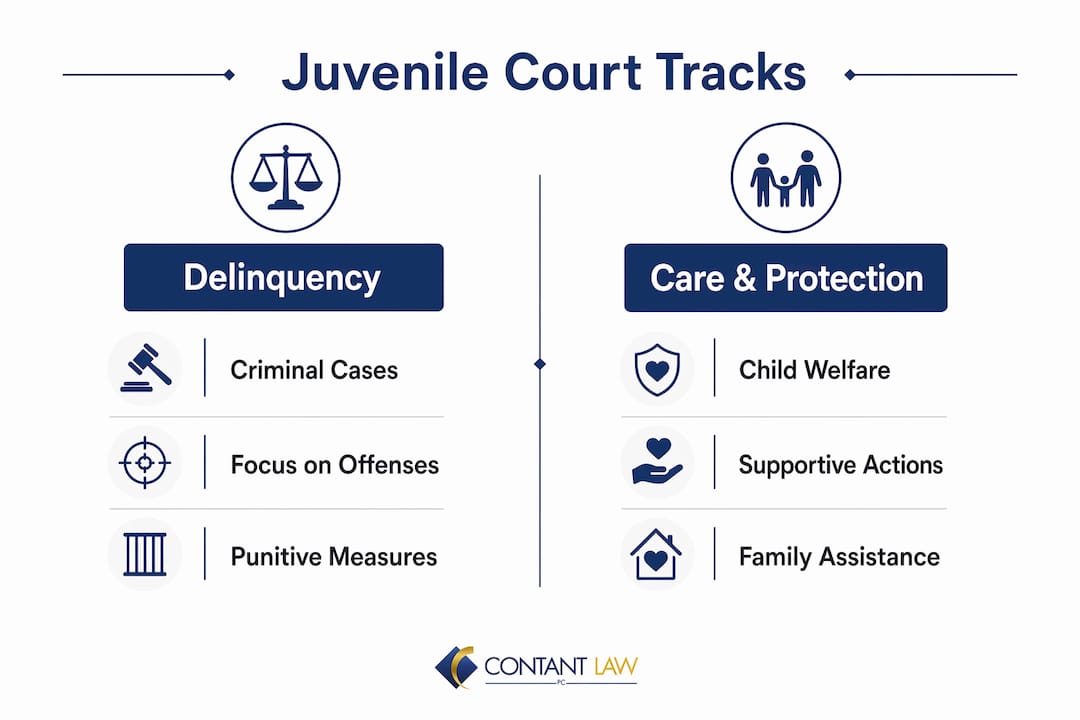
DCF has statutory authority to remove children on an emergency basis and initiate protective custody hearings within 72 hours as the first step in these cases. That 72-hour window moves fast. Families who are unprepared can find themselves at a significant disadvantage before they fully understand what is happening.
Key features of care and protection proceedings include:
- Initiation by DCF, not by a criminal complaint or police report
- Temporary custody hearings held within days of emergency removal
- Preponderance of evidence standard, which is a lower bar than the “beyond a reasonable doubt” standard used in delinquency cases
- Possible outcomes including supervised custody, family services, or termination of parental rights
- Constitutional due process protections for parents, including the right to appointed counsel
Parents have constitutional due process rights, including legal counsel appointment, in care and protection cases. A guardian ad litem is also appointed to represent the child’s interests separately. These cases are high-stakes and move quickly, which is why retaining counsel the moment DCF becomes involved is the right call.
What is the role of parents and guardians during the juvenile court process?
Parents are not passive observers in juvenile court. Your presence, cooperation, and preparation directly shape how the court perceives your child’s situation.

Your responsibilities include attending every court appearance, communicating openly with your child’s attorney, and providing behavioral and family context that the judge will consider during disposition. Judges in Massachusetts juvenile court rigorously evaluate the child’s needs and the evidence, not just the charge itself. A parent who shows up prepared and engaged sends a clear signal to the court.
Common responsibilities for parents during the process:
- Cooperate with juvenile probation officers, who prepare reports that influence disposition
- Provide accurate background information to your child’s attorney, including school records, mental health history, and family circumstances
- Understand confidentiality rules, since juvenile proceedings are generally closed to the public but records still exist
- Avoid discussing the case publicly or on social media, which can complicate legal strategy
- Learn about record sealing, since juvenile records are not automatically sealed at age 18 and require a formal petition
Pro Tip: Ask your child’s attorney to walk you through the probation officer’s role before the disposition hearing. Understanding what that report will say, and how to address it, can meaningfully affect the outcome.
One misconception worth addressing directly: juvenile court is not lenient. Many families mistakenly believe juvenile court is informal, but judges apply rigorous legal standards. Treating the process casually is one of the most common and costly mistakes parents make. You can learn more about what to do after a charge to stay ahead of each stage.
What diversion and record sealing options exist for juveniles in Massachusetts?
Diversion programs and continuance without a finding (CWOF) are two of the most valuable tools available in the Massachusetts juvenile court system. Both allow a juvenile to avoid a formal delinquency finding on their record, which has lasting consequences for education, employment, and housing.
Diversion programs and CWOF offer alternatives to adjudication and help protect a juvenile’s record. Eligibility varies by county and by the nature of the offense. Early legal review is the only reliable way to determine whether your child qualifies. You can also review pretrial diversion basics to understand what these programs typically require.
| Option | What it means | Key condition |
|---|---|---|
| Diversion program | Case resolved outside court through services or counseling | Must meet county-specific eligibility criteria |
| CWOF | Charges placed on hold; dismissed if conditions are met | Requires compliance with court-ordered terms |
| Record sealing | Formal petition to restrict public access to juvenile record | Timing and case disposition determine eligibility |
| Expungement | Full removal of record in limited circumstances | Stricter eligibility than sealing; not widely available |
Sealing eligibility depends heavily on case disposition and later court involvement. This means the decisions made early in the case, including whether to pursue a CWOF or accept a delinquency finding, directly affect whether the record can be sealed later. Early legal strategy is not just about the immediate outcome. It is about protecting your child’s future. For families concerned about long-term consequences, protecting a minor’s future after arrest is a practical starting point. Courts also consider behavioral health factors, and programs like behavioral health and substance abuse treatment are often part of diversion conditions.
Key Takeaways
Successful navigation of the Massachusetts juvenile court process requires understanding its two-track structure, active parental involvement, and early legal decisions that protect a juvenile’s long-term record.
| Point | Details |
|---|---|
| Two distinct tracks | Delinquency and care/protection cases follow separate procedures, standards, and outcomes. |
| No jury in juvenile court | A judge alone decides guilt and disposition, making legal preparation and presentation critical. |
| Parents play an active role | Attending hearings, cooperating with attorneys, and providing context directly shapes case outcomes. |
| Record sealing is not automatic | Formal petition and timing are required; early case strategy determines future eligibility. |
| Diversion is worth pursuing early | CWOF and diversion programs can prevent a formal delinquency finding if pursued before adjudication. |
What I’ve learned about families who succeed in juvenile court
After working with families across Massachusetts, one pattern stands out clearly: the families who achieve the best outcomes are the ones who treat juvenile court with the same seriousness they would bring to any adult criminal proceeding.
The myth that juvenile court is a softer system leads families to delay hiring counsel, skip pretrial conferences, or assume a first offense will simply disappear. That assumption is wrong and expensive. Early decisions profoundly affect whether records can be sealed or expunged, and those decisions happen in the first weeks of a case, not at the end.
What actually works is a coordinated effort: an attorney who understands both the legal merits and the behavioral context, parents who show up prepared and engaged, and a clear strategy around diversion or CWOF from the very first hearing. Rehabilitation is genuinely part of the juvenile court’s mission in Massachusetts. But the court still expects legal rigor. Families who understand that balance give their child the best possible chance.
— Contant Law
Contant-law is ready to help your family through juvenile court
Contant Law, P.C. represents juveniles and their families across Massachusetts juvenile court divisions, with offices in Woburn and Newburyport. The firm handles every stage of the process, from arraignment through disposition, and works to identify diversion eligibility and record sealing opportunities from the start. Parents who engage Contant-law early gain a clearer picture of the process, stronger preparation for each hearing, and a legal strategy built around their child’s long-term future. To speak with a juvenile defense attorney about your child’s case, visit the Contant-law services page or contact the firm directly to arrange a consultation.
FAQ
What are the main steps in the Massachusetts juvenile court process?
The process moves from complaint application and arraignment through pretrial conferences, adjudicatory hearing, and disposition. A judge, not a jury, decides the outcome at every stage.
Can a juvenile’s record be sealed automatically at age 18 in Massachusetts?
No. Juvenile records in Massachusetts are not automatically sealed at age 18. Sealing requires a formal petition, and eligibility depends on case disposition and subsequent court involvement.
What is a continuance without a finding (CWOF) in juvenile court?
A CWOF places charges on hold rather than entering a delinquency finding. If the juvenile meets all court-ordered conditions, the charges are dismissed, protecting the record from a formal finding.
What is the role of parents during juvenile court proceedings in Massachusetts?
Parents attend hearings, provide behavioral and family context to the court, cooperate with probation officers, and work closely with defense counsel throughout the process.
What is the difference between a delinquency case and a care and protection case?
Delinquency cases involve charges against a juvenile for an alleged offense. Care and protection cases are initiated by DCF when a child’s safety at home is in question, and they use a lower burden of proof.
Recommended
- Steps To Take When Your Child Is Charged With A Juvenile Offense | Contant Law, P.C.
- What To Do If Your Child Is Charged With A Crime In MA | Contant Law, P.C.
- Navigating The Legal Process For Juveniles Tried As Adults | Contant Law, P.C.
- Navigating The MA District Court Criminal Process | Contant Law, P.C.


