

TL;DR:
- Massachusetts district courts primarily handle misdemeanors and low-level felonies with sentences up to five years. Early legal intervention, especially at the clerk-magistrate hearing, can prevent charges from proceeding and improve outcomes. Defendants have important rights and should seek qualified legal help before arraignment to maximize their chances of a favorable resolution.
Massachusetts district courts are defined as the primary venue for criminal proceedings involving misdemeanors and certain felonies carrying sentences of up to five years. If you are facing a criminal charge in Massachusetts, your case will almost certainly begin here. District courts have initial jurisdiction for all criminal matters in the state, meaning arraignments, bail hearings, and pretrial motions all take place in this court first. Understanding how district court criminal cases in Massachusetts work gives you a real advantage before you ever step inside a courtroom.
What types of criminal cases are heard in Massachusetts district courts?
District courts handle all misdemeanors and a significant portion of felony charges in Massachusetts. Misdemeanors are offenses punishable by up to two and a half years in a house of correction. Felonies punishable by up to five years can also be initiated and resolved in district court, without ever moving to superior court.
Common charges heard in district court include:
- OUI/DUI (operating under the influence of alcohol or drugs)
- Drug possession and minor drug distribution offenses
- Assault and battery, including domestic violence charges
- Shoplifting and larceny under a certain dollar threshold
- Trespassing and vandalism
- Traffic violations that carry criminal penalties
The distinction between district court and superior court matters because it affects the severity of charges, the type of jury available, and the sentencing range.
| Feature | District Court | Superior Court |
|---|---|---|
| Offense type | Misdemeanors, lower-level felonies | Serious felonies, grand jury indictments |
| Maximum sentence | Up to 5 years | More than 5 years, up to life |
| Jury size | 6 jurors | 12 jurors |
| Initial proceedings | Yes, for all criminal charges | No, cases transfer from district court |

Some felony cases start in district court but transfer to superior court after a grand jury indictment. That transfer is not automatic. Many serious charges are resolved entirely at the district court level through plea agreements or dismissals.
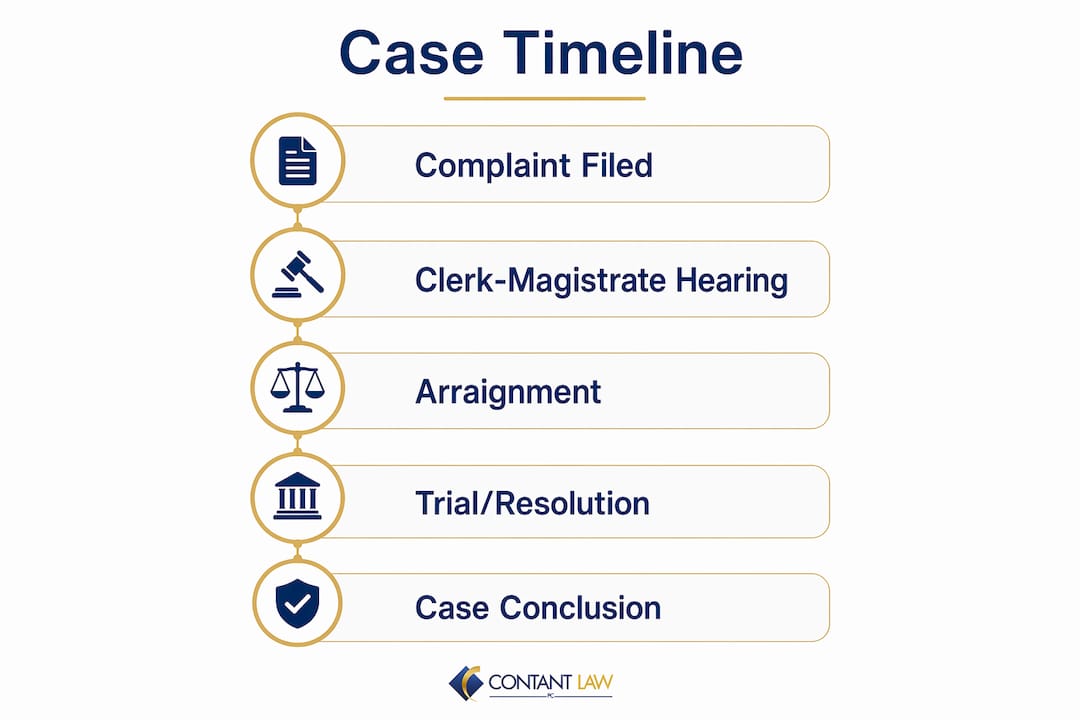
What is the typical criminal case timeline in Massachusetts district court?
The criminal case process in Massachusetts district court follows a defined sequence of steps. Knowing what comes next reduces anxiety and helps you prepare.
- Clerk-Magistrate hearing. Before a formal complaint is issued, a clerk-magistrate reviews the evidence to determine whether probable cause exists. This screening phase can stop a case before it officially begins, which is a significant but often overlooked opportunity for defendants.
- Arraignment. The court formally reads the charges against you, and you enter a plea of guilty or not guilty. Bail conditions are also set at this stage.
- Pretrial conference. Your attorney and the prosecutor meet to discuss the case, share evidence, and explore whether a resolution is possible without going to trial.
- Pretrial motions. Your attorney may file motions to suppress illegally obtained evidence or to dismiss charges entirely. These motions can dramatically change the direction of your case.
- Trial. If no agreement is reached, the case proceeds to trial before a judge or a six-person jury.
- Sentencing. If you are found guilty, the judge imposes a sentence. District court sentences typically include fines, probation, community service, or incarceration in a house of correction.
Pro Tip: The clerk-magistrate hearing is one of the most underutilized opportunities in Massachusetts criminal defense. If your attorney presents strong arguments at this stage, the case may never reach arraignment.
What rights do defendants have in Massachusetts district court criminal cases?
Your rights as a defendant in Massachusetts district court are clearly defined and legally protected. Knowing them is not optional. It is the foundation of your defense.
- Right to counsel. Under SJC Rule 3:10, every defendant has the right to an attorney. If you cannot afford one, the court appoints representation at no cost to you.
- Right to discovery. You have the right to review all evidence the prosecution plans to use against you, including police reports, witness statements, and physical evidence.
- Right to file pretrial motions. Your attorney can file motions to suppress evidence obtained through illegal searches or improper police conduct. A successful suppression motion can result in charges being dropped entirely.
- Right to bail. You have the right to request bail or release on personal recognizance. The judge weighs factors like flight risk and public safety when setting conditions.
- Right to a speedy trial. Massachusetts law requires that your case move forward within a reasonable timeframe. Unreasonable delays can be grounds for dismissal.
Pro Tip: Never waive your right to counsel, even if the charge seems minor. A misdemeanor conviction can affect your employment, housing, and professional licenses for years.
The right to appointed counsel under SJC Rule 3:10 applies regardless of the severity of the charge. That protection exists because the consequences of a conviction, even for a low-level offense, can follow you for a long time.
How can district court criminal cases typically conclude?
District court cases in Massachusetts resolve in several ways, and not all of them end in a conviction. The outcome depends heavily on the strength of the evidence, the skill of your attorney, and the specific facts of your case.
Common resolutions include:
- Dismissal. Charges are dropped due to insufficient evidence, a successful pretrial motion, or a procedural error by the prosecution.
- Continuance Without a Finding (CWOF). You admit to sufficient facts but do not enter a guilty plea. After a probationary period, the case is dismissed. This outcome avoids a formal conviction on your record.
- Plea agreement. You plead guilty to a reduced charge in exchange for a lighter sentence. Plea agreements are negotiated between your attorney and the prosecutor.
- Trial verdict. If the case goes to trial, a judge or jury delivers a verdict of guilty or not guilty.
- Transfer to superior court. If a grand jury issues an indictment, the case moves to superior court for trial on more serious felony charges.
| Outcome | What it means for you |
|---|---|
| Dismissal | No conviction, no criminal record for that charge |
| CWOF | Probation period, then dismissal if conditions are met |
| Plea agreement | Reduced charge or sentence, formal conviction on record |
| Not guilty verdict | Full acquittal, no conviction |
| Transfer to superior court | Case escalates, more serious penalties possible |
Case outcomes at the district court level vary widely. Early legal intervention gives you the best chance at a favorable resolution before the case gains momentum.
Key Takeaways
Massachusetts district courts handle the majority of criminal cases in the state, and the outcome of your case depends on understanding the process, asserting your rights, and securing qualified legal counsel from the start.
| Point | Details |
|---|---|
| District court jurisdiction | Covers all misdemeanors and felonies with sentences up to five years in Massachusetts. |
| Clerk-Magistrate hearing | This early screening phase can stop a case before formal charges are filed. |
| Defendant rights | SJC Rule 3:10 guarantees appointed counsel for defendants who cannot afford an attorney. |
| Case outcomes | Dismissal, CWOF, plea agreements, and trial verdicts are all possible resolutions. |
| Early legal help | Retaining an attorney before arraignment gives you the strongest possible defense position. |
What I have learned from district court criminal cases in Massachusetts
After years of representing clients in Massachusetts district courts, one pattern stands out clearly: the defendants who fare best are the ones who act early. Most people wait until after arraignment to contact an attorney. By then, they have already missed the clerk-magistrate hearing, which is often the single best opportunity to prevent a case from moving forward at all.
District court feels less intimidating than superior court, and that perception works against defendants. People assume a misdemeanor charge is not serious enough to warrant aggressive defense. That assumption is wrong. A conviction for assault and battery or OUI in district court carries real consequences, including license suspension, probation, and a permanent criminal record that shows up on background checks.
The pretrial phase is where most cases are actually won or lost. Charge dismissal strategies and suppression motions require preparation, legal knowledge, and a clear understanding of the evidence. Showing up to court without that preparation is the most common and most costly mistake I see defendants make.
— Contant Law
Facing a district court charge? Contant-law is ready to help
Contant-law represents individuals facing criminal charges in Massachusetts district courts, with offices in Woburn and Newburyport. The firm handles OUI, drug offenses, assault, domestic violence, and a full range of misdemeanor and felony matters from the clerk-magistrate stage through trial. If you have been charged or summoned to court, the time to act is before your arraignment, not after. Visit the Contant-law services page to review the firm’s criminal defense practice areas, or go directly to contant-law.com to request a consultation and speak with an attorney about your specific situation.
FAQ
What crimes go to district court in Massachusetts?
Massachusetts district courts handle all misdemeanors and felonies with maximum sentences of up to five years, including OUI, drug possession, assault, and domestic violence charges.
What happens at a clerk-magistrate hearing in Massachusetts?
A clerk-magistrate reviews the evidence to decide whether probable cause exists to issue a formal criminal complaint. A strong defense at this stage can prevent charges from being filed at all.
Can a district court case be dismissed before trial?
Yes. Charges can be dismissed through pretrial motions, including motions to suppress evidence or motions to dismiss based on insufficient probable cause or procedural errors.
Do I have the right to a lawyer in Massachusetts district court?
Every defendant has the right to legal counsel under SJC Rule 3:10. If you cannot afford an attorney, the court appoints one at no cost to you.
What is a Continuance Without a Finding (CWOF) in Massachusetts?
A CWOF is a resolution where you admit to sufficient facts without entering a guilty plea. After completing a probationary period, the case is dismissed and you avoid a formal conviction on your record.


