

Leaving the scene of an accident in Massachusetts is a criminal offense under Massachusetts General Laws Chapter 90, Section 24, and the consequences begin the moment you drive away. The law imposes an affirmative duty on every driver involved in a collision to stop immediately, make known their name, home address, and vehicle registration number, and remain until those obligations are fulfilled. Failing to do so triggers criminal charges, mandatory license suspension, and potential civil liability, regardless of whether the accident was your fault.
The core legal elements the Commonwealth must prove are:
- You operated a motor vehicle
- A collision occurred while you were operating it
- You knew the collision happened
- You left without stopping and providing your identifying information
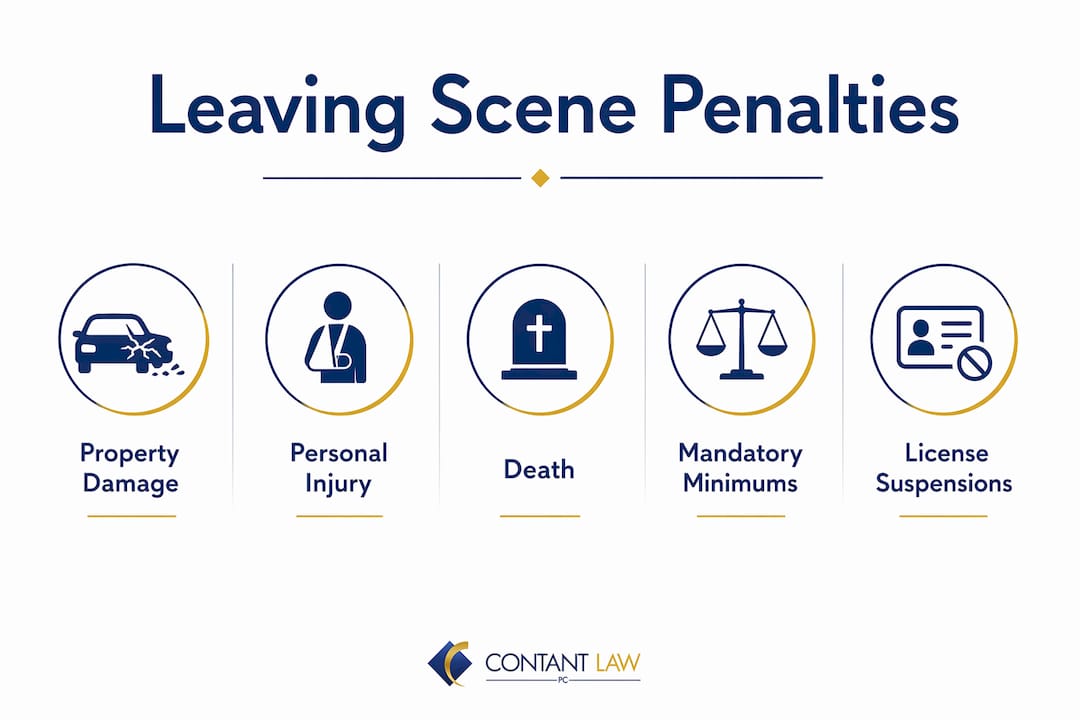
The offense is incident-based, meaning a single act of leaving the scene constitutes one charge regardless of how many vehicles or people were involved. Charges escalate across three tiers depending on what the accident caused: property damage, personal injury, or death.
What are the different types of leaving the scene charges in Massachusetts?
Massachusetts law separates hit and run offenses into three distinct categories, each carrying its own elements and severity.

Property damage is the least serious tier, governed by G.L. c. 90, § 24(2)(a). The Commonwealth must prove you operated a motor vehicle, caused damage to another vehicle or property, knew you caused that damage, and left without providing your name, address, and registration number. The extent of the damage is not a legal element; it may only serve as circumstantial evidence of whether you knew a collision occurred.
Personal injury is charged under G.L. c. 90, § 24(2)(a½)(1) when the accident injures another person but does not result in death. The knowledge requirement remains central: the prosecution must prove you were aware you collided with or injured someone. The severity of the injury does not change the charge level, though it affects how vigorously prosecutors pursue the case.
Death elevates the offense to a felony under G.L. c. 90, § 24(2)(a½)(2). This tier adds one element the others lack: the driver must have left specifically “to avoid prosecution or evade apprehension.” In practice, fleeing the scene of a fatal crash almost always satisfies that element. The District Court lacks jurisdiction over this felony charge, so it proceeds in Superior Court.
One detail that catches many people off guard: stopping somewhere down the road and calling police does not satisfy the statute. The duty is to stop at the scene and actively provide your information. Merely being willing to answer questions if asked falls short of what the law requires.
What are the penalties for leaving the scene in Massachusetts?
Penalties escalate sharply across the three tiers, and the most serious carry mandatory minimums a judge cannot waive.
| Offense | Classification | Jail/Prison | Fine |
|---|---|---|---|
| Property damage | Misdemeanor | 2 weeks–2 years (house of correction) | $20–$200 |
| Personal injury | Misdemeanor | Min. 6 months–2 years | $500–$1,000 |
| Death | Felony | 2.5–10 years (state prison) | $1,000–$5,000 |
For the property damage tier, the court has discretion to impose a fine, jail time, or both. A first offense may result in a relatively modest penalty, but the criminal record is real and permanent.
The personal injury tier carries a mandatory minimum of 6 months in a house of correction. That minimum cannot be suspended, and courts typically do not allow a continuance without a finding on this charge. You serve the time.
The death tier is the most severe. A conviction carries a mandatory minimum of 2.5 years in state prison, and the sentence cannot be reduced below one year, suspended, or made eligible for probation, parole, or furlough until at least one year has been served. The only narrow exceptions involve attending a relative’s funeral, visiting a critically ill relative, obtaining emergency medical care, or participating in a work release program.
Beyond incarceration and fines, every conviction triggers a mandatory license suspension through the Registry of Motor Vehicles:
- Property damage, first offense: a period of license suspension
- Property damage, repeat offenses: a longer suspension
- Personal injury, first offense: a substantial suspension
- Personal injury with a prior conviction: an extended suspension
Reinstatement is not automatic. You must pay a reinstatement fee to the RMV and may be required to carry an SR-22 certificate of financial responsibility, which signals to the RMV that you are a high-risk driver and results in significantly higher insurance premiums for years after the conviction.
What defenses are available against a leaving the scene charge?
The most effective defenses attack the elements the prosecution must prove, particularly the knowledge requirement.
Lack of knowledge of the collision is the most common defense. Because the statute uses the word “knowingly,” the Commonwealth must prove you were actually aware a collision occurred. If road conditions, vehicle noise, or the minor nature of the contact made it genuinely plausible you did not realize anything happened, that creates reasonable doubt. This defense is strongest when there is no visible damage to your vehicle and no witnesses who can testify you reacted to the impact.
Emergency circumstances offer another recognized path. If you left the scene because of an immediate threat to your personal safety or because you needed urgent medical attention, your departure may be legally justified. Vague claims of feeling unsafe rarely hold up in court. Medical records showing you drove yourself to an emergency room, or witness testimony describing a threatening situation at the scene, carry far more weight.
Challenges to identification evidence can also be effective. The prosecution must prove beyond a reasonable doubt that you were the operator of the vehicle. In cases relying on circumstantial evidence, an experienced attorney can challenge whether the evidence is sufficient to place you behind the wheel.
Pro Tip: Contact a criminal defense attorney before speaking with police. Anything you say after leaving the scene can be used to establish the “knowledge” element the prosecution needs. An attorney can help you respond in a way that does not inadvertently confirm you knew about the collision.
For the death tier specifically, a defendant who left but turned themselves in to police shortly afterward may argue they did not leave “to avoid prosecution or evade apprehension.” The practical value of this argument varies, but surrendering quickly almost always improves your legal position compared to being located days later.
What happens after you are charged with leaving the scene?
The legal process moves through several stages, each with its own deadlines and decisions.
Arraignment is your first court appearance, where the charge is formally read and you enter a plea. For misdemeanor property damage cases, this occurs in District Court. Personal injury misdemeanors also begin in District Court, while the felony death charge proceeds in Superior Court.
Evidence gathering and plea negotiations follow arraignment. Your attorney will review police reports, witness statements, surveillance footage, and any physical evidence from the scene. Many cases resolve through plea negotiations, particularly for first-time offenders facing the property damage tier.
Sentencing hearings apply when a guilty plea or verdict is reached. For personal injury and death cases, the mandatory minimums remove much of the court’s discretion, which is why fighting the charge at the evidence stage matters so much.
Administrative license suspension runs parallel to the criminal process. The RMV imposes the suspension upon conviction, separate from any sentence the court orders. Reinstatement requires:
- Completion of the suspension period
- Payment of the RMV reinstatement fee
- SR-22 filing if required by the RMV
- Compliance with any court-ordered conditions
| Milestone | Typical Timeline |
|---|---|
| Arraignment | Within days of charge |
| Pre-trial hearings | Weeks to months post-arraignment |
| Trial or plea | Months after arraignment |
| License suspension begins | Upon conviction |
| Reinstatement eligibility | After suspension period ends |
Compliance with all court orders and reporting requirements throughout this process directly affects your ability to resolve the case favorably.
Civil liability and reporting requirements after leaving the scene
Criminal charges and civil lawsuits run on entirely separate tracks. A conviction does not end your legal exposure; it often makes the civil case against you stronger.
Massachusetts sets the statute of limitations for personal injury claims at three years from the date of injury under Chapter 260, Section 2A. That window gives injured parties time to identify you and file suit even after the criminal case concludes. A civil lawsuit can recover damages that criminal restitution does not touch, including compensation for pain and suffering, emotional distress, and, when your conduct reflects reckless disregard for others’ safety, punitive damages.
Massachusetts law also imposes mandatory accident reporting obligations. You must report any accident involving injury or property damage above a certain threshold to both police and your insurance company. Failing to file that report can result in license suspension and registration revocation by the RMV, entirely separate from any criminal charges. It also creates complications when your insurer investigates a claim.
When the owner of a damaged vehicle or property is not present at the scene, you are still required to make a reasonable effort to locate them. If you cannot, leaving a written note with your contact information and a description of the accident satisfies that obligation. Driving away without doing so converts an accident into a criminal offense.
Long-term consequences beyond fines and jail time
A leaving the scene conviction follows you well past the end of your sentence. The criminal record is permanent and publicly accessible, which creates obstacles that extend into nearly every area of life.
Employment is one of the most immediate concerns. Many employers conduct background checks, and a criminal conviction, particularly a felony for a death-related offense, can disqualify you from jobs in transportation, healthcare, education, and government. Even misdemeanor convictions can raise red flags for employers who require a clean driving record or work with vulnerable populations.
Professional licensing boards in Massachusetts routinely review criminal histories. A conviction can jeopardize licenses in fields such as nursing, law, real estate, and financial services. The board’s response depends on the severity of the offense and how recently it occurred, but the obligation to disclose is typically immediate.
Insurance costs remain elevated for years. Carriers classify a hit and run conviction as a serious traffic offense, and your premiums reflect that risk assessment long after the SR-22 requirement ends.
Immigration status can also be affected for non-citizens. A felony conviction, and in some circumstances a misdemeanor with a sentence of one year or more, may trigger removal proceedings or affect applications for naturalization or visa renewal.
Common scenarios that lead to leaving the scene charges
Understanding how these charges arise in real situations helps clarify where the legal line falls.
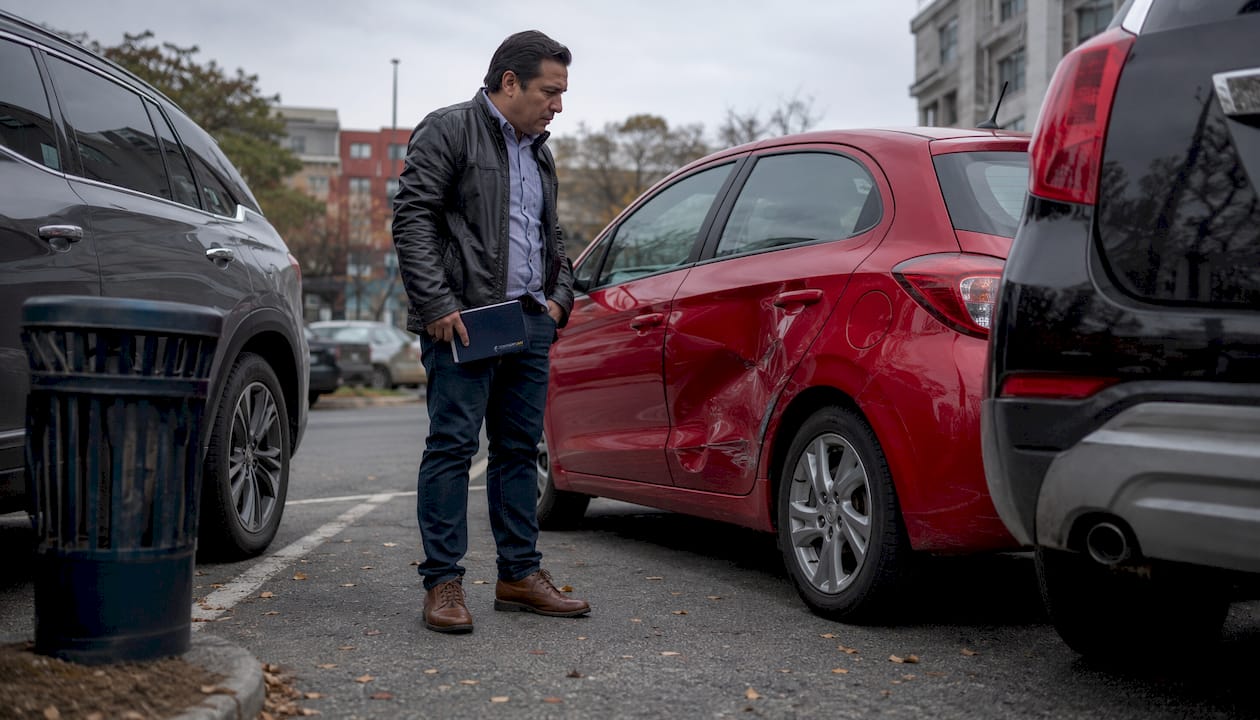
Parking lot incidents are among the most frequent. A driver clips a parked car while maneuvering, notices the damage, and drives away without leaving a note. Even if the damage appears minor, this is a criminal offense under Massachusetts law.
Low-speed collisions at intersections often lead to charges when a driver taps another vehicle, both parties appear uninjured, and one driver decides to keep moving. If the other driver did not get your information, you have violated the statute regardless of fault.
Striking a pedestrian or cyclist and continuing is treated with particular seriousness by prosecutors, especially when injury results. Witnesses, traffic cameras, and cell phone footage make these cases easier to investigate than many drivers expect.
Panicked departure after a serious crash accounts for many felony-level cases. A driver causes a severe accident, fears the consequences, and flees. The decision to leave compounds the original offense dramatically and eliminates much of the goodwill that prompt cooperation might have generated.
Unattended property damage, such as knocking over a mailbox or scraping a fence, still requires you to make a reasonable effort to notify the property owner or leave your contact information.
How law enforcement investigates leaving the scene cases
Police investigating a hit and run have more tools available than most drivers realize, and the window for identification is often shorter than people expect.
Traffic and business surveillance cameras cover a large portion of Massachusetts roadways, particularly in urban and suburban areas. Officers routinely canvass nearby businesses and intersections for footage within hours of a reported incident. License plate reader data, which many Massachusetts police departments collect continuously, can place a specific vehicle in a specific location at a specific time.
Witness accounts gathered at the scene often include partial plate numbers, vehicle descriptions, and direction of travel. Combined with camera footage, this information frequently narrows the field to a single vehicle quickly. Physical evidence on the suspect vehicle, including paint transfer, broken glass, or body damage consistent with the collision, can then confirm the match.
Social media plays a growing role as well. Witnesses post photos and videos of accidents in real time, and investigators monitor those posts. In some cases, the driver themselves posts something that places them at the scene.
Once a suspect is identified, police will typically seek a statement. That is the moment when having experienced legal counsel becomes most critical. What you say, and how you say it, can determine whether the prosecution can establish the knowledge element they need to secure a conviction.
If you are facing a leaving the scene charge in Massachusetts, Contant-law’s criminal defense team at Contant Law, P.C. is ready to review your case, explain your options, and build the strongest possible defense on your behalf.
Key Takeaways
Leaving the scene of an accident in Massachusetts carries criminal penalties, mandatory license suspension, and civil liability that persist long after the case closes.
| Point | Details |
|---|---|
| Three offense tiers | Charges range from a misdemeanor for property damage with a $20–$200 fine and/or 2 weeks to 2 years in a house of correction, to a misdemeanor for personal injury with a mandatory minimum of 6 months up to 2 years and a $500–$1,000 fine, up to a felony carrying 2.5–10 years in state prison and a $1,000–$5,000 fine when death results. |
| Mandatory minimums apply | Personal injury convictions carry a mandatory minimum 6-month jail sentence that cannot be suspended; death convictions require at least one year served before any eligibility for parole, probation, or release. |
| Knowledge is the key element | The prosecution must prove you knew the collision occurred; lack of that knowledge is the most common and effective defense. |
| Civil liability runs separately | Injured parties have three years from the date of injury to file a civil lawsuit, regardless of the criminal outcome. |
| Reporting failures compound exposure | Failing to report the accident to police and your insurer can trigger additional license suspension and insurance coverage disputes. |
FAQ
What is the penalty for leaving the scene of an accident in Massachusetts?
Penalties depend on what the accident caused. Property damage carries a fine of $20–$200 and up to two years in a house of correction; personal injury carries a mandatory minimum of six months and a fine of $500–$1,000; and a death-related offense is a felony with 2.5–10 years in state prison and a $1,000–$5,000 fine.
How can you beat a leaving the scene charge in Massachusetts?
The strongest defense is proving you did not know the collision occurred, since the statute requires the prosecution to establish that knowledge beyond a reasonable doubt. Emergency circumstances, such as fleeing a genuine threat or seeking urgent medical care, can also justify departure if supported by solid evidence like medical records or witness testimony.
Will your insurance pay if you leave the scene of an accident?
Your own insurer may deny or dispute your claim if you fail to report the accident promptly, and the missing police report creates coverage complications. The other party’s uninsured motorist coverage, which is mandatory in Massachusetts, typically becomes their primary source of compensation for bodily injury when the at-fault driver flees.
Is fleeing the scene worse than staying after a DUI?
From a purely legal standpoint, leaving the scene adds a separate criminal charge on top of any underlying offense, including an OUI. Staying and cooperating, while potentially resulting in an OUI charge, avoids the mandatory minimums and felony exposure that a leaving the scene conviction can carry, particularly when someone is injured or killed.


