

TL;DR:
- In Massachusetts, third and subsequent OUI offenses automatically become felonies, with escalating penalties. An OUI also becomes a felony if it results in serious injury or death, regardless of prior convictions. Convictions remain on your criminal record for life, but driving records can be cleared after 10 years with a formal request.
An OUI (Operating Under the Influence) is a felony in Massachusetts starting at the third offense, or immediately when the incident causes serious bodily injury or death. Massachusetts uses the term OUI rather than DUI, though both refer to the same offense: operating a vehicle while impaired by alcohol or drugs. Under Massachusetts General Laws (M.G.L.) c. 90, first and second OUI offenses are misdemeanors. The third offense triggers automatic felony status, and certain aggravated circumstances can elevate even a first offense to a felony. Knowing where your charge falls on this scale is the first step toward understanding what you are facing.
Is an OUI a felony in Massachusetts based on offense count?
Massachusetts classifies OUI charges on a clear escalating scale. The number of prior convictions on your record determines whether you face a misdemeanor or a felony.

First and second offenses: misdemeanors
A first offense OUI carries a maximum of 2.5 years in jail and a fine up to $5,000, along with a one-year license suspension. That maximum sentence is rarely imposed for a first offense, but the possibility exists. A second offense remains a misdemeanor but brings steeper penalties, including a mandatory ignition interlock device (IID) requirement upon license reinstatement.
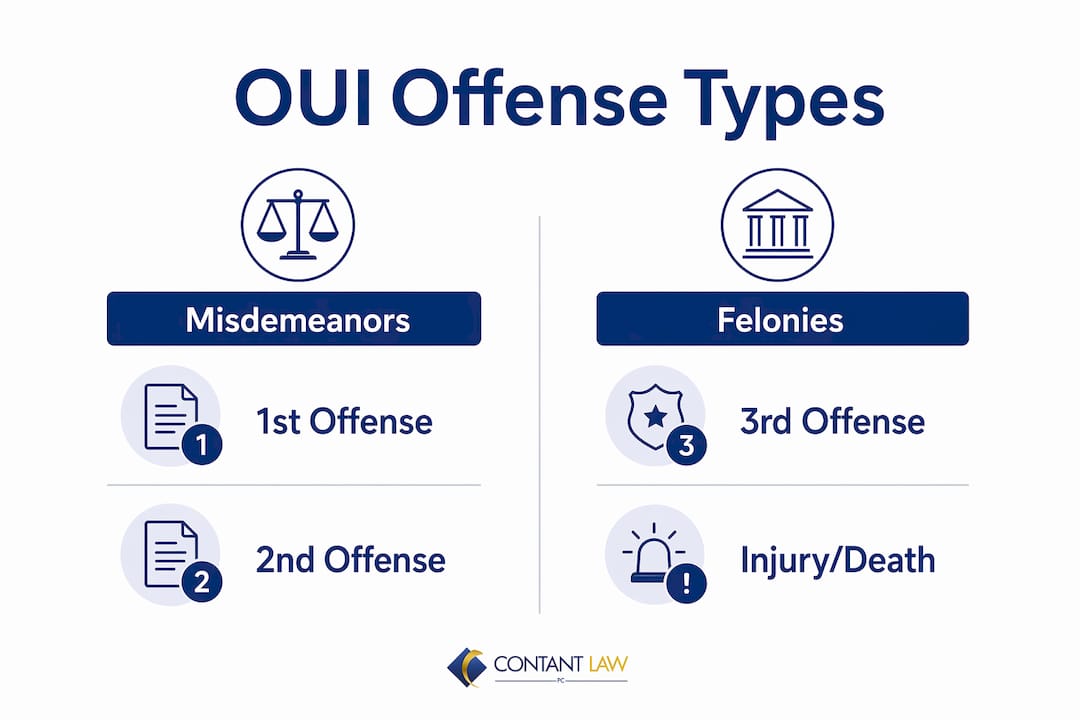
Third and subsequent offenses: felonies
A third offense OUI is automatically a felony under Massachusetts law. The penalties reflect that elevated status:
- Jail time: At least 150 days, up to 5 years in state prison
- Fine: $1,000–$15,000
- License suspension: 8 years
- IID: Mandatory upon reinstatement
Each subsequent offense after the third carries longer minimums. A fourth offense requires a minimum of 1 year in jail and a fine between $1,500 and $25,000. A fifth or higher offense carries a minimum of 24 months in jail, fines between $2,000 and $50,000, and lifetime license revocation. That lifetime revocation is permanent. There is no path back to driving privileges after a fifth conviction.
When does a first OUI become a felony?
Offense count is not the only trigger for felony status. Massachusetts law creates a separate felony category for OUI incidents that cause serious harm, regardless of your prior record.
Under M.G.L. c. 90, § 24L, an OUI charge escalates to a felony when it results in serious bodily injury or death. This applies even to a first-time offender. OUI manslaughter can carry penalties up to 15 years in state prison. That is a longer potential sentence than a standard third-offense felony OUI.
Serious bodily injury includes broken bones, permanent disfigurement, loss of a limb, or any injury that creates a substantial risk of death. A single-car accident where a passenger is seriously hurt qualifies. A crash that kills another driver qualifies. The law does not require a prior record to impose felony-level consequences in these situations.
Pro Tip: If your OUI charge involves an accident with injuries, treat it as a felony matter from day one, even if this is your first offense. The charges can escalate quickly, and early legal representation makes a measurable difference in how the case develops.
What are the penalties for felony vs. misdemeanor OUI charges?
Understanding the full penalty range helps you assess what is at stake. The table below compares OUI penalties by offense level under Massachusetts law.
| Offense level | Classification | Jail time | Fine | License suspension |
|---|---|---|---|---|
| First offense | Misdemeanor | Up to 2.5 years | Up to $5,000 | 1 year |
| Second offense | Misdemeanor | Up to 2.5 years | Up to $10,000 | 2 years |
| Third offense | Felony | 150 days–5 years | $1,000–$15,000 | 8 years |
| Fourth offense | Felony | 1 year minimum | $1,500–$25,000 | 10 years |
| Fifth or more | Felony | 24 months minimum | $2,000–$50,000 | Lifetime |
| OUI causing injury/death | Felony | Up to 15 years | Varies | Varies |
Beyond jail and fines, several additional consequences apply across offense levels:
- Ignition interlock devices: IID use is mandated for second and subsequent offenses as a condition of license reinstatement.
- Hardship licenses: Available for some offenders during suspension periods, but eligibility narrows significantly with each felony conviction.
- Probation: Courts frequently impose probation alongside or instead of jail time for lower-level offenses.
- Alcohol education programs: Required for first offenders who seek a continuance without a finding (CWOF), a deferred disposition option that avoids a formal conviction.
The full range of OUI fines and associated costs extends well beyond the statutory amounts once you factor in court fees, attorney fees, and increased insurance premiums.
How does an OUI affect your criminal and driving records?
An OUI conviction stays on your criminal record permanently in Massachusetts. There is no automatic expungement after a set number of years. Your driving record tells a different story. OUI convictions on your driving record can be removed after 10 years upon a formal request to the Registry of Motor Vehicles (RMV). That distinction matters because insurers and employers often check both records separately.
The long-term consequences of a felony OUI reach well beyond the courtroom:
- Employment: Many employers conduct criminal background checks. A felony OUI can disqualify you from jobs requiring a commercial driver’s license (CDL), security clearance, or professional license.
- Insurance: Auto insurance rates increase substantially after any OUI conviction. A felony conviction can result in policy cancellation.
- Travel: A felony conviction can restrict entry into Canada and other countries.
- Chemical test refusals: Massachusetts is an implied consent state, meaning refusing a breathalyzer triggers an automatic administrative license suspension. That refusal is not a criminal offense, but it affects your license independently of any court outcome.
Record sealing is possible for some OUI convictions under Massachusetts law, but felony OUI cases face stricter eligibility requirements and waiting periods. An attorney can assess whether sealing is an option in your specific situation.
Key Takeaways
A third OUI offense in Massachusetts is automatically a felony, and any OUI causing serious injury or death is a felony regardless of prior record.
| Point | Details |
|---|---|
| Felony threshold | Third offense OUI and any OUI causing injury or death are felonies under Massachusetts law. |
| Misdemeanor range | First and second OUI offenses are misdemeanors, though jail time is still possible. |
| Escalating penalties | Fines and jail minimums increase with each offense, reaching lifetime revocation at five or more. |
| Permanent criminal record | OUI convictions stay on your criminal record for life; driving records can be cleared after 10 years. |
| IID requirement | Ignition interlock devices are mandatory for reinstatement starting with the second offense. |
What I’ve learned defending OUI cases in Massachusetts
After years of representing clients facing OUI charges across Massachusetts, one pattern stands out clearly. People consistently underestimate how quickly a misdemeanor OUI situation can shift into felony territory. A second offense with an accident, a prior conviction from another state that counts toward your Massachusetts total, or a passenger who sustains an injury can all change the charge classification before you fully understand what happened.
The other misconception I see regularly is that a first offense is “not serious.” A first OUI is a misdemeanor, but it carries real consequences including possible jail time, a one-year license suspension, and a permanent criminal record. How you handle a first offense also shapes your exposure if you are ever charged again. A continuance without a finding (CWOF) on a first offense still counts as a prior OUI for sentencing purposes on a second charge. That surprises many people.
The most practical advice I can offer is this: contact a defense attorney before you speak to anyone else. The decisions made in the first 48 hours after an OUI arrest often determine the trajectory of the entire case.
— Contant Law
Facing an OUI charge in Massachusetts?
Contant-law represents clients facing OUI charges at every level, from first-offense misdemeanors to felony cases involving serious injury. The firm’s attorneys understand Massachusetts OUI law in detail and work to protect your rights from the first consultation through resolution. Whether you are trying to understand your charge classification, the penalties you may face, or your options for license reinstatement, Contant-law provides clear guidance without the legal jargon. Offices are located in Woburn and Newburyport. You can reach the Contant-law legal team to discuss your case and understand your options.
FAQ
Is a first OUI a felony in Massachusetts?
No. A first OUI offense in Massachusetts is a misdemeanor, carrying a maximum of 2.5 years in jail and a fine up to $5,000. It becomes a felony only if it causes serious bodily injury or death.
What makes an OUI a felony in Massachusetts?
An OUI is a felony at the third offense or beyond, or when the incident results in serious bodily injury or death under M.G.L. c. 90, § 24L. OUI manslaughter can carry up to 15 years in state prison.
Does an OUI stay on your record forever in Massachusetts?
An OUI conviction stays on your criminal record permanently. Your driving record can be cleared after 10 years upon a formal request to the Registry of Motor Vehicles.
What is the difference between OUI and DUI in Massachusetts?
Massachusetts uses the term OUI (Operating Under the Influence) rather than DUI (Driving Under the Influence), but both refer to the same offense. The legal standards and penalties are the same regardless of which term is used.
Can you get a hardship license after a felony OUI in Massachusetts?
Hardship licenses are available in some felony OUI cases, but eligibility becomes more restricted with each conviction. A third-offense felony OUI carries an eight-year suspension, and hardship license availability depends on the specific facts of your case and your compliance with court requirements.


