

TL;DR:
- The Essex County criminal defense process involves multiple legal stages from initial charges to final resolution.
- Early legal representation is crucial, especially at clerk magistrate hearings and arraignments, to protect your rights and improve your case outcome.
The Essex County criminal defense process is defined as the sequence of legal proceedings that moves a criminal case from initial charge through arraignment, pre-trial motions, trial, and final resolution in Massachusetts courts. If you are facing criminal charges in Essex County, understanding each stage gives you a real advantage. Essex County spans 34 cities and towns with a population around 810,000, served by district courts in Lynn, Salem, Peabody, Lawrence, Haverhill, Newburyport, Gloucester, and Ipswich, plus Superior Court sessions in Salem and Lawrence. That geographic spread means your case venue matters as much as the charges themselves.
What happens after criminal charges are filed in Essex County?
The first stage of the Essex County criminal defense process begins before you ever set foot in a courtroom. Clerk Magistrate hearings and arraignments are separate proceedings with distinct purposes, and confusing the two is one of the most common mistakes defendants make.

A Clerk Magistrate hearing is a preliminary procedure. The magistrate reviews whether probable cause exists to issue a criminal complaint. Magistrates issue criminal complaints and conduct probable cause hearings before any formal charge is entered on your record. This hearing is your first real opportunity to prevent a case from moving forward at all.
If a complaint issues, the next step is arraignment. At arraignment, charges are formally read and you enter a plea of guilty, not guilty, or no contest. The court also addresses bail at this stage. Bail conditions can restrict your movement, employment, and daily life, so having an attorney present at arraignment is critical.
Key facts about the early stages:
- District courts in Lynn, Salem, and Lawrence handle the highest volume of criminal cases in northern Essex County.
- Massachusetts District Courts hear felonies punishable by up to five years, misdemeanors, and ordinance violations.
- Bail can be set, modified, or waived at arraignment based on your criminal history and the nature of the charge.
- You have the right to an attorney at every stage, including the Clerk Magistrate hearing.
Pro Tip: If you receive a notice for a Clerk Magistrate hearing, retain an attorney before that date. Winning at this stage means no arraignment, no public record of charges, and no bail conditions.
How do pre-trial motions shape the defense in Essex County?
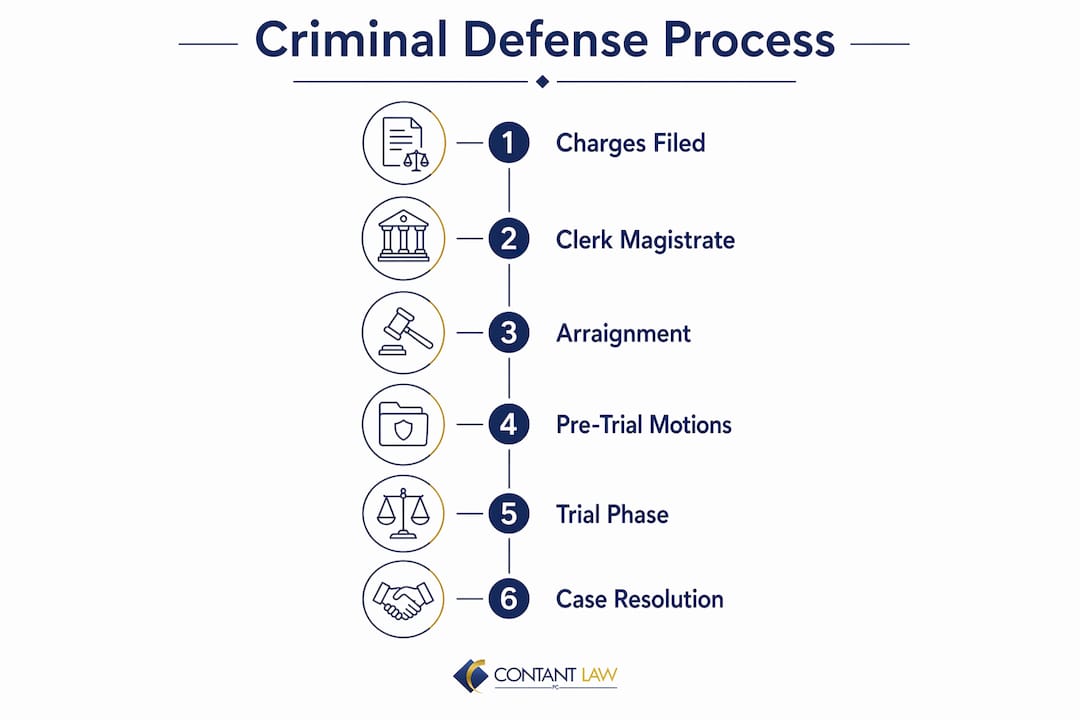
Pre-trial motions are the most powerful tools in criminal defense, and they are filed after arraignment but before any trial begins. The Massachusetts District Court criminal process includes a structured pre-trial phase where your attorney can challenge the government’s case directly.
Pre-trial motions such as motions to dismiss or suppress evidence can eliminate charges or weaken the prosecution’s case before a single juror is seated. A motion to suppress, for example, challenges evidence obtained through an unlawful search. If the court grants it, that evidence cannot be used against you.
Common motions filed in Essex County courts include:
- Motion to Dismiss: Argues the complaint lacks legal sufficiency or the prosecution cannot meet its burden.
- Motion to Suppress Evidence: Challenges evidence gathered in violation of your Fourth Amendment rights.
- Motion for Discovery: Compels the prosecution to share police reports, witness statements, and forensic results.
- Motion for a Probable Cause Hearing: Requests a formal hearing to determine whether the case should proceed to Superior Court.
Discovery is particularly important. Once you receive the prosecution’s evidence, your attorney can identify weaknesses, inconsistencies in witness accounts, or procedural errors by law enforcement. Plea negotiations also happen during this phase. Prosecutors often offer reduced charges or lighter sentences in exchange for a guilty plea, and the strength of your pre-trial motions directly affects the quality of any offer you receive.
Pro Tip: Never accept a plea deal before your attorney has reviewed all discovery materials. A strong motion to suppress can change the entire negotiating dynamic in your favor.
What should defendants expect during the trial phase in Essex County courts?
Trial is the stage most defendants fear, but understanding the structure removes much of that anxiety. District Courts accommodate jury and bench trials for appropriate cases, while Superior Courts handle serious felony trials. The court where your case is tried affects the procedures, the jury pool, and the sentencing range.
A typical trial in Essex County follows these steps:
- Jury selection (voir dire): Both sides question potential jurors and may remove those who appear biased.
- Opening statements: Each side outlines what the evidence will show. This is not testimony; it is a preview.
- Prosecution’s case: The government presents witnesses and physical evidence. Your attorney cross-examines each witness.
- Defense case: You may present witnesses and evidence, though you are never required to testify.
- Closing arguments: Both sides summarize the evidence and argue why the verdict should favor their position.
- Verdict: The jury or judge delivers a finding of guilty or not guilty.
| Trial stage | Your attorney’s role |
|---|---|
| Jury selection | Challenge biased jurors, shape the panel |
| Cross-examination | Expose inconsistencies in prosecution witnesses |
| Defense case | Present evidence and witnesses strategically |
| Closing argument | Frame the reasonable doubt standard for the jury |
Your right not to testify is absolute under the Fifth Amendment. The jury cannot hold your silence against you. That protection is real, and a skilled defense attorney will remind the jury of it during closing arguments.
How are criminal cases resolved in Essex County?
Criminal cases in Essex County resolve through plea agreements, dismissals, convictions, or appeals. Each outcome carries different consequences, and your attorney’s goal is to reach the best possible result given the facts of your case.
Plea agreements resolve the majority of criminal cases before trial. A plea deal typically involves pleading guilty to a reduced charge in exchange for a lighter sentence. The judge must accept the agreement, and you have the right to withdraw your plea before sentencing in limited circumstances.
Post-trial options include:
- Direct appeal: You may appeal a conviction to the Massachusetts Appeals Court within 30 days of sentencing.
- Motion for a new trial: Filed when new evidence emerges or when constitutional errors affected the verdict.
- Probation review: If sentenced to probation, violations can result in incarceration, so understanding your conditions is critical.
- Pretrial diversion: For eligible defendants, judicial diversion programs offer court-supervised alternatives to conviction, particularly for first-time offenders.
Sentencing in District Court differs from Superior Court. District Court sentences are generally capped at two and a half years in a house of correction, while Superior Court can impose state prison sentences. Knowing which court holds your case shapes every decision your attorney makes.
Key Takeaways
The Essex County criminal defense process moves through defined stages, and early legal representation at each phase is the single most effective way to protect your rights and improve your outcome.
| Point | Details |
|---|---|
| Clerk Magistrate hearing | Win here and no formal charge enters your record; retain counsel before this date. |
| Arraignment and bail | Your plea and bail conditions are set at arraignment; an attorney changes the outcome. |
| Pre-trial motions | Motions to suppress or dismiss can eliminate evidence or end the case before trial. |
| Trial court selection | District Court and Superior Court carry different sentencing ranges and procedures. |
| Post-trial options | Appeals and motions for a new trial remain available after conviction within set timelines. |
What I have learned defending cases in Essex County courts
After years of representing clients across Essex County, the pattern I see most often is this: defendants wait too long to get an attorney. They assume the Clerk Magistrate hearing is informal, or that arraignment is just paperwork. Both assumptions cost people dearly.
Understanding local court culture matters more than most defendants realize. The Lawrence District Court, the Salem District Court, and the Newburyport District Court each have their own procedural rhythms, and experienced local counsel knows how to work within them. A motion strategy that works well in one venue may need adjustment in another.
The second mistake I see is defendants who talk too much, to police, to prosecutors, and even to friends. Every statement you make before consulting an attorney can be used against you. The Fifth Amendment exists for a reason. Use it.
Finally, do not underestimate the pre-trial phase. Most cases are won or lost before the jury is ever seated. A well-timed motion to suppress, a thorough review of clinical mitigation strategies, or a well-negotiated plea can produce a result that trial never could. The courtroom is the last resort, not the first.
— Contant Law
How Contant-law supports clients through Essex County criminal cases
Contant-law represents clients at every stage of the criminal process across Essex County, from Clerk Magistrate hearings in Newburyport to felony trials in Salem Superior Court. The firm handles DUI/OUI, drug charges, assault, domestic violence, juvenile offenses, and traffic violations, with offices in both Woburn and Newburyport for convenient access across the region. Contant-law’s approach centers on clear communication: you will know what is happening in your case, why each decision is made, and what your options are at every turn. To learn more about the firm’s criminal defense services or to schedule a consultation, visit Contant-law online.
FAQ
What is a Clerk Magistrate hearing in Massachusetts?
A Clerk Magistrate hearing is a preliminary proceeding where a magistrate determines whether probable cause exists to issue a criminal complaint. Winning at this stage prevents formal charges from appearing on your record.
Which courts handle criminal cases in Essex County?
Essex County district courts in Lynn, Salem, Lawrence, Haverhill, Newburyport, Peabody, Gloucester, and Ipswich handle most criminal matters, while the Superior Courts in Salem and Lawrence handle serious felonies.
Can criminal charges be dropped before trial in Essex County?
Yes. A successful motion to dismiss or motion to suppress evidence can result in charges being dropped before trial. Plea agreements and pretrial diversion programs also resolve cases without a trial verdict.
What is the difference between District Court and Superior Court in Essex County?
District Court handles misdemeanors and felonies punishable by up to five years, with sentences capped at two and a half years in a house of correction. Superior Court handles serious felonies with state prison sentences as a possible outcome.
When should I hire a criminal defense attorney in Essex County?
Retain an attorney as soon as you learn you are under investigation or receive a notice for a Clerk Magistrate hearing. Early representation gives your attorney the most time to build a defense and the best chance to prevent formal charges.


