

TL;DR:
- Massachusetts District Court handles misdemeanors and some felonies with penalties up to five years in a house of correction. The Superior Court manages more serious felonies and high-value civil cases exceeding $50,000. Understanding which court is involved affects your rights, process, and potential outcomes.
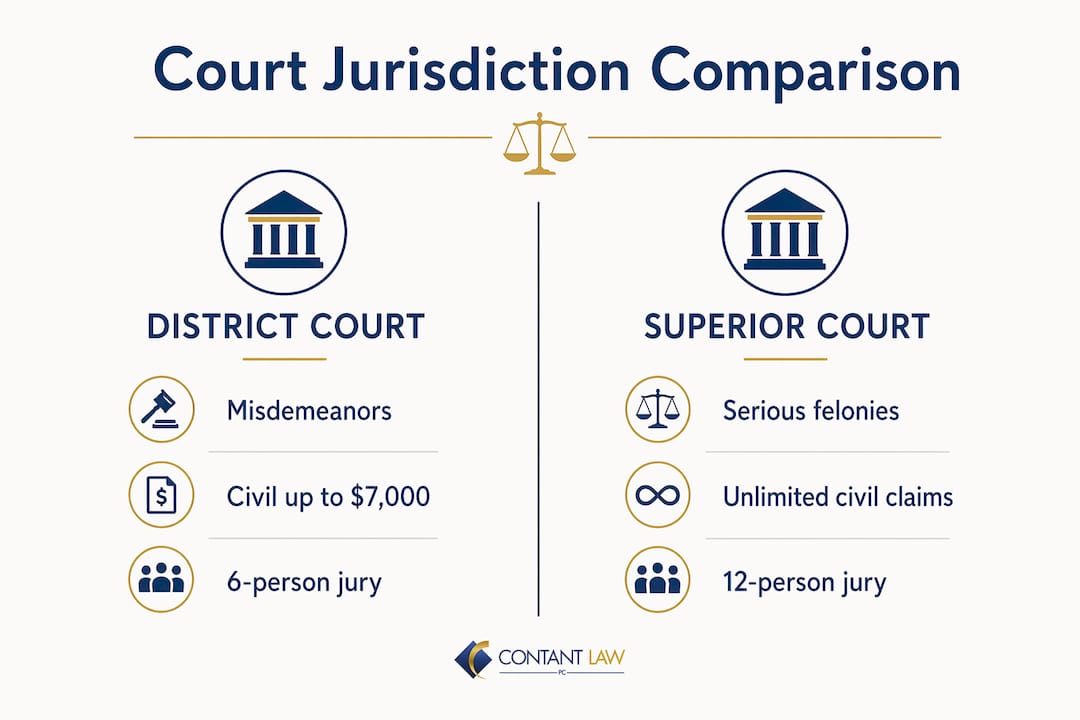
Massachusetts District Court is defined as a court of limited jurisdiction that handles misdemeanors and felonies where the maximum penalty does not exceed 5 years in a house of correction. Understanding the difference between district court vs superior court Massachusetts is critical if you are facing criminal charges or a civil dispute. The Superior Court, by contrast, handles the most serious felonies and civil cases exceeding $50,000. Where your case lands in the court system directly affects your rights, your timeline, and the strategy your attorney must build from day one.
What types of criminal cases does each court handle in Massachusetts?
The criminal jurisdiction split between these two courts is the most consequential difference for defendants. The District Court has original jurisdiction over all misdemeanors and felonies with penalties up to 5 years in a house of correction. The Superior Court takes over when a felony carries a potential sentence beyond that threshold.
Here is how that breaks down in practice:
- District Court criminal cases: Operating under the influence (OUI), drug possession, assault and battery, shoplifting, trespassing, and most traffic offenses
- Superior Court criminal cases: Armed robbery, rape, murder, trafficking offenses, and any felony where the sentence could exceed 5 years in state prison
- Exclusive Superior Court jurisdiction: Murder charges and other serious violent felonies that Massachusetts law reserves exclusively for the Superior Court
- Jury size difference: District Court uses a 6-person jury; Superior Court uses a 12-person jury, which changes the dynamics of trial strategy significantly
One procedural right that many defendants do not know about is the trial de novo. If you are convicted after a bench trial in District Court, you can appeal for a new trial in Superior Court. That appeal is not a review of the original decision. The prosecution must prove its case entirely from scratch, and your District Court conviction is set aside.
Pro Tip: If you are charged with a misdemeanor in District Court, choosing a bench trial over a jury trial preserves your right to a full jury trial in Superior Court if the outcome is unfavorable. That strategic option disappears if you start with a jury trial in District Court.

How do civil case values determine which court hears your case?
Civil jurisdiction in Massachusetts follows a clear monetary threshold. The District Court handles civil claims valued at $7,000 or less, including Small Claims matters. Cases valued between $7,000 and $50,000 occupy a middle range that may be heard in District Court under certain conditions. The Superior Court holds jurisdiction over any civil case exceeding $50,000.
| Court | Civil jurisdiction | Case types |
|---|---|---|
| District Court | Up to $7,000 (Small Claims and general civil) | Contract disputes, property damage, personal injury below threshold |
| District Court | Up to $50,000 in some circumstances | General civil matters within statutory limits |
| Superior Court | Over $50,000, unlimited ceiling | Complex commercial disputes, high-value personal injury, equity cases |
The Superior Court’s unlimited civil jurisdiction also covers equity matters and injunctions, which District Court cannot grant. This matters if you need a court order to stop someone from doing something, not just a money judgment.
Pro Tip: If your personal injury case involves significant medical bills, lost wages, or long-term damages, filing in Superior Court from the start avoids the monetary cap and gives you access to broader discovery tools. You can learn more about evaluating personal injury cases before deciding where to file.
What procedural differences matter most for defendants?
The pace of District Court is one of its most defining features. District Court cases move rapidly compared to Superior Court, which means you have less time to prepare, gather evidence, and build a defense. That speed is not an accident. District Court handles a high volume of cases, and the system is built for efficiency.
Discovery timelines reflect this difference directly. District Court discovery is compressed, giving both sides less time to exchange evidence and conduct depositions. Superior Court allows for more thorough discovery, which benefits defendants in complex cases where the evidence requires careful analysis.
Key procedural contrasts for defendants include:
- Trial speed: District Court resolves cases faster, which can be an advantage or a liability depending on your preparation level
- Jury composition: A 6-person jury in District Court versus a 12-person jury in Superior Court affects deliberation dynamics and the likelihood of a hung jury
- Bail hearings: Initial bail hearings almost always occur in District Court, even if the case will later move to Superior Court
- Sentencing exposure: District Court sentences are capped by its jurisdiction; Superior Court sentences can include decades in state prison
Pro Tip: Do not treat a District Court appearance as a minor formality. The Massachusetts District Court criminal process moves quickly, and early decisions about bail, arraignment, and plea options can shape everything that follows.
How does the Massachusetts court system move cases between courts?
The Massachusetts court system uses a concurrent jurisdiction model for certain felonies. This means some offenses can be prosecuted in either District Court or Superior Court, depending on the severity of the charges and whether a grand jury issues an indictment.
The flow of cases through the system follows a predictable path:
- Arraignment in District Court: Nearly all criminal arraignments, bail hearings, and probable cause determinations begin in District Court, regardless of where the case will ultimately be tried.
- Probable cause hearing: District Court determines whether sufficient evidence exists to hold the defendant for further proceedings.
- Grand jury indictment: For serious felonies destined for Superior Court, a grand jury reviews the evidence and issues a formal indictment. This step is exclusive to Superior Court prosecution.
- Transfer to Superior Court: Once indicted, the case moves from District Court to Superior Court, where the full trial process begins under Superior Court rules.
Understanding this flow matters because decisions made at the District Court stage, including bail conditions and preliminary hearings, carry forward and affect your position in Superior Court. You can read more about clerk magistrate hearings to understand how early proceedings shape the case.
Key Takeaways
The most important distinction in the Massachusetts court system is jurisdictional: District Court handles less severe criminal and civil matters, while Superior Court holds authority over serious felonies and high-value civil cases.
| Point | Details |
|---|---|
| Criminal jurisdiction threshold | District Court handles felonies with penalties up to 5 years; Superior Court handles everything above that. |
| Civil monetary limits | District Court covers claims up to $7,000; Superior Court covers cases exceeding $50,000 with no ceiling. |
| Trial de novo right | A District Court bench trial conviction can be appealed to Superior Court for a completely new jury trial. |
| Case pacing | District Court moves faster with compressed discovery; Superior Court allows more time for complex preparation. |
| Grand jury requirement | Only Superior Court prosecutions require a grand jury indictment for serious felony charges. |
What I have learned from watching defendants misread these courts
The most damaging mistake I see is when someone treats a District Court case as low-stakes because the court sounds less serious than Superior Court. That assumption is wrong and costly. District Court convictions carry real consequences, including license suspensions, probation, and criminal records that follow you for years.
The second mistake is waiting too long to get legal counsel. Because District Court moves fast, defendants who show up unprepared or without an attorney often find themselves agreeing to plea deals that a prepared defense could have challenged or improved. The trial de novo option is powerful, but it is far better to build a strong defense from the start than to rely on a second chance.
The third thing worth saying plainly: the court where your case is heard is not always your choice, but how you respond to that court’s procedures absolutely is. Knowing whether you face a 6-person or 12-person jury, whether discovery is compressed, and whether a bench trial preserves your appeal rights gives you real leverage. That knowledge only helps you if you act on it early.
— Contant Law
How Contant-law helps Massachusetts residents navigate both courts
Facing charges in either court requires a defense built around that court’s specific rules, timelines, and procedures. Contant-law represents clients across Massachusetts in both District Court and Superior Court criminal matters, including OUI, drug offenses, assault, domestic violence, and serious felony charges. The firm’s attorneys understand how early decisions at arraignment and bail hearings shape outcomes at every stage that follows. If you are facing charges and need to understand your options, the legal services at Contant-law cover the full range of criminal defense work in both courts. Reach out to the team at Contant-law to discuss your case and get clear answers about where your matter stands.
FAQ
What is the main difference between District Court and Superior Court in Massachusetts?
District Court handles misdemeanors and felonies with penalties up to 5 years, while Superior Court handles more serious felonies and civil cases exceeding $50,000. The courts also differ in jury size, discovery timelines, and sentencing authority.
Can a District Court case move to Superior Court in Massachusetts?
Yes. Serious felony cases begin with arraignment in District Court but transfer to Superior Court after a grand jury indictment. Defendants convicted in District Court bench trials can also request a trial de novo in Superior Court.
What is a trial de novo in Massachusetts?
A trial de novo is a completely new jury trial in Superior Court available to defendants convicted after a bench trial in District Court. The original conviction is set aside, and the prosecution must prove its case from the beginning.
Does District Court handle jury trials in Massachusetts?
Yes, District Court conducts jury trials using a 6-person jury. Superior Court uses a 12-person jury. The choice between a bench trial and a jury trial in District Court has strategic implications for appeal rights.
What civil cases go to Superior Court in Massachusetts?
Superior Court handles civil cases exceeding $50,000, including complex commercial disputes, high-value personal injury claims, and equity matters such as injunctions. District Court is limited to civil claims at or below $7,000 in most circumstances.


